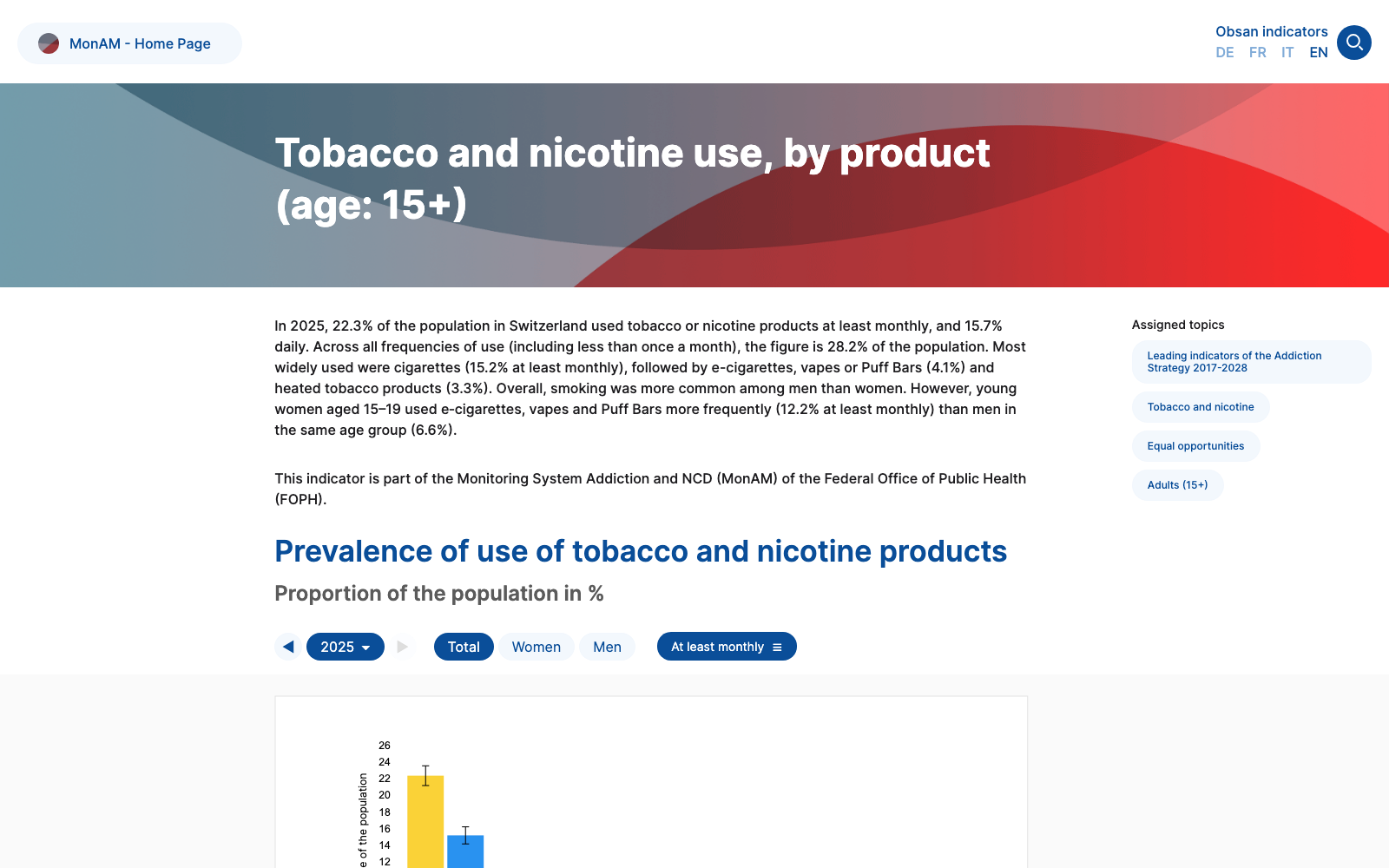
Quick answer: Swiss vape use data from the 2025 MonAM indicator says 4.1% of Switzerland’s population aged 15 and older used e-cigarettes, vapes, or Puff Bars at least monthly, behind cigarettes at 15.2% and ahead of heated tobacco products at 3.3%. For VapeRisk readers, the important signal is category diversification: vapes are no longer a fringe data point in official nicotine monitoring.
| Fact | Detail |
|---|---|
| Primary source | MonAM indicator from the Federal Office of Public Health and Obsan |
| Last updated | May 12, 2026 |
| Jurisdiction | Switzerland |
| Headline data point | 4.1% monthly use of e-cigarettes, vapes, or Puff Bars among people aged 15+ |
| Buyer / retailer relevance | Official monitoring separates vapes, cigarettes, heated tobacco, oral products, and other nicotine categories |
What does the Swiss vape use data show?
The MonAM indicator says 22.3% of Switzerland’s population aged 15 and older used tobacco or nicotine products at least monthly in 2025, while 15.7% used them daily. Across all use frequencies, including less than monthly use, the figure was 28.2%.
Within the product categories, cigarettes remained the largest monthly-use category at 15.2%. E-cigarettes, vapes, or Puff Bars followed at 4.1%, ahead of heated tobacco products at 3.3%.
Why is the age 15-19 split notable?
MonAM also reports a narrower youth signal: among people aged 15-19, young women used e-cigarettes, vapes, or Puff Bars at least monthly more often than young men, at 12.2% versus 6.6%.
That split does not explain why the difference exists, and it should not be overread as a product-performance claim. It does show why official monitoring systems increasingly separate vapes and Puff Bars from older tobacco categories.
VapeRisk risk read
The risk signal is about category tracking. Retailers, policymakers, and product analysts should avoid treating all nicotine products as one bucket. Swiss data now makes it easy to compare cigarettes, vapes, heated tobacco, oral products, and other nicotine categories inside one official indicator.
That matters for product files because intake records should identify the exact format: disposable, pod, refillable device, heated tobacco product, pouch, or other oral nicotine product. VapeRisk’s retailer intake-file guide uses the same product-specific approach.
What remains unverified?
The indicator is population monitoring, not a product test. It does not measure a specific device’s emissions, verify a brand’s claims, or explain whether one flavor, package design, or retail channel drove the reported use levels. It also cannot be directly mapped onto U.S. or UK retail behavior without separate local data.
Buyer and retailer watch list
- Track product format and nicotine category separately in retail records.
- Do not use broad “nicotine product” statistics to support a specific vape product claim.
- Watch official indicators for youth subgroup movement, especially where vapes and Puff Bars are separated from heated tobacco.
- Compare population-use signals with enforcement and product-claim coverage before making stocking decisions.
Related VapeRisk Coverage
- Retail shelf risk is the new vape media beat
- Youth vaping data keeps flavor, packaging and access under the microscope
FAQ
What did the Swiss vape use data show?
The Swiss vape use data showed that 4.1% of the population aged 15 and older used e-cigarettes, vapes, or Puff Bars at least monthly in 2025, according to MonAM.
Were vapes more common than cigarettes in the Swiss data?
No. Cigarettes remained more common at 15.2% monthly use, while e-cigarettes, vapes, or Puff Bars were reported at 4.1% and heated tobacco products at 3.3%.
Can this data prove why young people vape?
No. The MonAM indicator reports prevalence by category and group, but it does not prove why young people use a product or validate any specific brand claim.