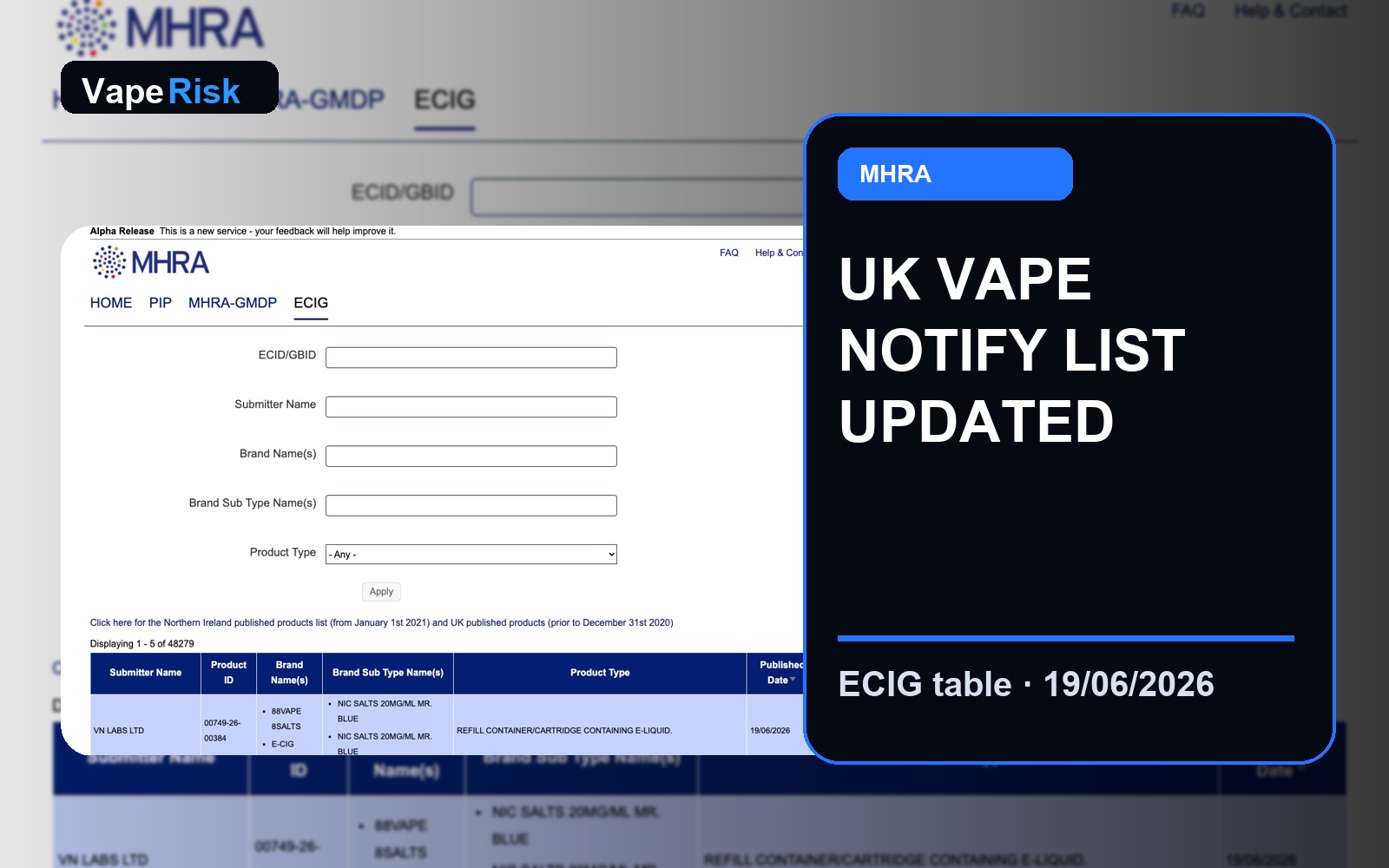
Quick answer: The MHRA ECIG list showed newly published vape records dated 19 June 2026, including refill-container and kit entries. That matters for UK vape compliance, but it should not be read as a safety endorsement. A notification record helps identify a product, submitter, and product type; it does not verify performance claims, puff counts, battery behavior, or buyer risk.
| Signal | Details |
|---|---|
| Source status | Official MHRA ECIG public table |
| Date visible in table | 19/06/2026 |
| Examples visible | 88VAPE 8SALTS refill-container entries and TUGBOAT kit entries |
| Reader relevance | Notification helps identify products, but it is not a risk-free badge |
What did the MHRA ECIG table show?
The MHRA ECIG public search page displayed new records with a published date of 19 June 2026. The visible rows included VN LABS LTD entries for 88VAPE 8SALTS nicotine-salt refill containers and a FUUMY TECHNOLOGY (DONGGUAN) CO., LTD. entry for TUGBOAT kit products.
The important point is not that these specific products are unusual. It is that the UK notification layer is visible, searchable, and highly specific. The table shows submitter names, product IDs, brand names, product type, and publication date. For compliance work, that specificity is the useful part.
Why does this matter for UK vape buyers and retailers?
UK vape notification can reduce identity confusion, but it does not replace claim verification. A product can be listed while still making marketing claims that need separate evidence. Puff count, battery life, screen accuracy, coil behavior, and flavor consistency are not proven by a database row.
For retailers, the risk is treating a listing as a blanket approval signal. VapeRisk has seen this problem repeatedly: a public regulatory record can help check whether a product identity exists, but the shelf decision still needs matched paperwork, packaging checks, and supplier accountability.
What is the VapeRisk risk read?
The risk is over-reading notification. A clean ECID or GBID match is helpful, especially when products move through multiple distributors, but it should be one line in the intake file, not the whole file. Retailers should match the exact product, nicotine strength, submitter, brand name, and product type before relying on a listing.
For readers who want the background, VapeRisk’s ECID guide explains why UK notification is a product-identity tool rather than a hands-on safety test.
What remains unverified?
The public table does not prove how these products perform in real use. It does not verify puff-count marketing, e-liquid consistency, coil durability, leak resistance, counterfeit risk, or whether every retailer listing is tied to the exact same notified item.
Buyer and retailer watch list
- Match ECID or GBID to the exact product and packaging.
- Check nicotine strength and bottle or cartridge format.
- Ask suppliers for product-identification records, not just a brand-level assurance.
- Do not treat notification as a lab result or performance review.
FAQ
What changed on the MHRA ECIG list?
The MHRA ECIG public table showed entries published on 19 June 2026, including refill-container and kit records tied to brands such as 88VAPE 8SALTS and TUGBOAT.
Does an MHRA ECIG listing mean a vape is risk-free?
No. An ECIG listing is a notification and market-access signal. It does not prove performance, puff count, battery behavior, flavor quality, or low consumer risk.
What should retailers check after seeing a new listing?
Retailers should match the exact ECID or GBID, submitter, brand name, product type, packaging, nicotine strength, and supplier paperwork before treating a product as shelf-ready.