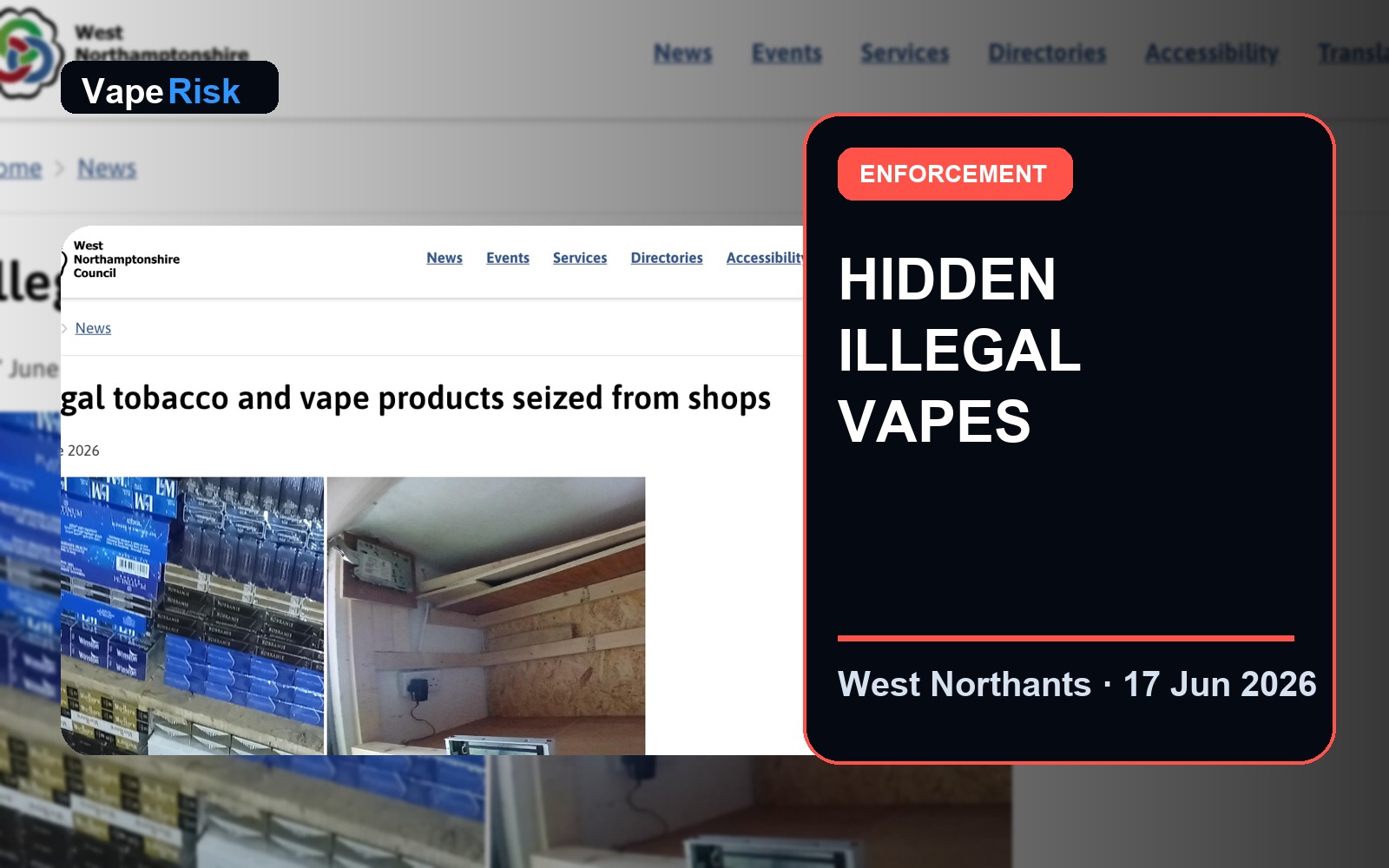
Quick answer: A new illegal vape seizure report from West Northamptonshire says Trading Standards officers found 26 illegal vapes during visits to three shops in Northampton and Daventry. The useful signal is not the count alone. It is that UK single-use vape ban enforcement is moving into ordinary retail checks, hidden stock searches, and follow-up action against shops.
| Signal | Details |
|---|---|
| Source status | Official West Northamptonshire Council news release |
| Publication date | 17 June 2026 |
| Reported vape count | 26 illegal vapes |
| Other items reported | 616 packets of illicit cigarettes and 26 pouches / 1.3 kg of illegal hand-rolling tobacco |
| Retail relevance | Single-use vape ban enforcement is now tied to shop visits and hidden-stock checks |
What happened in West Northamptonshire?
West Northamptonshire Council said its Trading Standards team visited three shops in Northampton and Daventry with support from Neighbourhood Wardens. The council said seizures were made at each shop and that officers found hidden storage in two cases, including one behind an electric-powered wall and another behind hinged shelving.
The council reported 616 packets of illicit cigarettes, 26 pouches or 1.3 kg of illegal hand-rolling tobacco, and 26 illegal vapes. It said the seized vapes were illegal under the UK single-use vape ban introduced in June last year and that the items would be destroyed.
Why does this matter for vape retailers?
This is a retail-floor enforcement story. Vape policy often looks abstract when it is discussed as national legislation, but the risk reaches shops when officers inspect stock, storage, and supplier records. The hidden-stock detail is especially important because it suggests enforcement teams are looking beyond products openly displayed on shelves.
For legitimate retailers, the case is another reason to keep a clear intake file for every vape product. VapeRisk’s UK single-use vape ban guide explains the product-design questions retailers should separate from general disposable-vape marketing language.
What is the VapeRisk risk read?
The immediate buyer risk is that banned or non-compliant stock can still surface through local retail channels. The business risk is sharper: Trading Standards action can involve seizures, destruction of goods, follow-up action, and potential restrictions on future trading.
For suppliers, the lesson is that product claims and import paperwork are not enough if the physical product format conflicts with the ban. For retailers, the key is to check whether a product is genuinely outside the single-use definition before stocking it.
What remains unverified?
The council release does not name the vape brands, product models, or suppliers. It also does not disclose whether the vapes were counterfeit, old stock, or recently supplied products. Without those details, this article should be read as an enforcement signal, not a brand-specific warning.
Buyer and retailer watch list
- Do not rely on a supplier’s verbal assurance that a product is legal.
- Keep invoices, product identity records, and compliance documents together.
- Separate reusable, refillable, and replacement-pod systems from banned single-use formats.
- Watch local Trading Standards updates for repeated patterns in your region.
FAQ
How many illegal vapes did West Northamptonshire report?
West Northamptonshire Council said Trading Standards uncovered 26 illegal vapes during visits to three shops in Northampton and Daventry.
Why is this seizure important?
It shows that UK single-use vape enforcement is not only about national policy. Local officers are checking shops, storage areas, and hidden stock.
Does one seizure prove a wider market trend?
No single local seizure proves the whole market, but it is a useful enforcement signal when read alongside the UK single-use vape ban and other local Trading Standards actions.