Nicotine has an immediate, measurable effect on your heart — and the bigger studies suggest the effect isn’t only short-term.
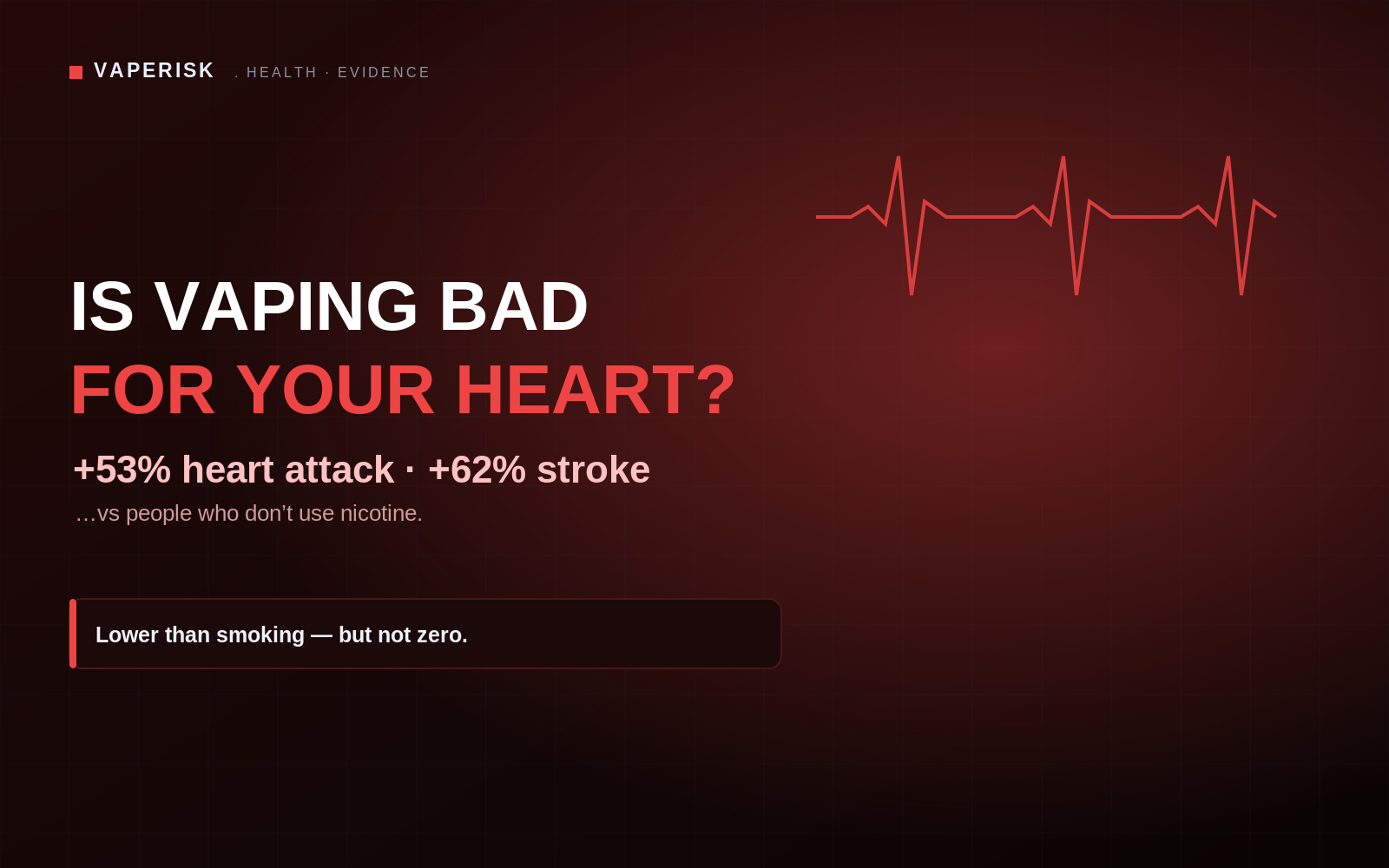
Quick answer: Yes — vaping affects your cardiovascular system. Nicotine raises heart rate and blood pressure within minutes, and large 2025–26 reviews link vaping to a higher risk of heart attack and stroke than not using nicotine at all: roughly +53% for heart attack and +62% for stroke versus non-users, plus modestly higher rates of heart failure and major cardiac events. These risks are lower than smoking and the long-term data is still maturing, but “lower than smoking” is not “no risk” — and for non-smokers there’s no upside to take the risk for.
General information, not medical advice. If you have heart concerns, speak to a healthcare professional.
The immediate effects
Every time you vape nicotine, your sympathetic nervous system fires: heart rate climbs, blood pressure rises, and blood vessels constrict. That’s well established and not really disputed. On its own an occasional bump isn’t dangerous for a healthy person, but repeated, daily activation is how short-term effects can become long-term strain — especially with fast-absorbing nicotine-salt formulations, which deliver nicotine quickly and at higher strengths.
What the larger studies found
The observational evidence has grown a lot, and it points one direction:
- A 2025 systematic review of over 1.5 million people found vapers had about a 53% higher risk of heart attack (odds ratio ~1.53) than non-users — with the risk especially notable in former smokers who keep vaping.
- A 2026 review of 26 studies and 900,000+ vapers reported higher odds of stroke (~+62%, OR 1.62), major adverse cardiac events (MACE, OR 1.57), and coronary heart disease (OR 1.19).
- NIH-funded work (2025) linked long-term vaping to impaired blood-vessel function and about a 19% higher risk of heart failure.
These are associations from mostly observational data, so they can’t prove vaping causes every event — but the consistency across large datasets is why cardiologists treat vaping as a genuine cardiovascular risk factor, not a neutral one.
Why it happens
Three mechanisms recur in the research: nicotine-driven increases in heart rate and blood pressure; inhaled fine particles and aerosol constituents triggering systemic inflammation and endothelial (blood-vessel lining) dysfunction; and oxidative stress that can accelerate arterial stiffening and atherosclerosis. Notably, studies associate reduced nicotine-salt exposure with lower arterial stiffness — a hint that the salt formulations dominating disposables and pods may be worse for arteries.
The balance: lower than smoking, not zero
Compared with cigarettes, vaping avoids combustion products, and inflammation biomarkers in vapers generally sit below smokers’. So for an adult who switches completely from smoking, the cardiovascular picture is likely an improvement. But two caveats matter: vaping risk still sits above not using nicotine at all, and dual use (vaping plus smoking) keeps you in the high-risk smoking category. If you don’t smoke, none of this is a trade worth making.
FAQ
Is vaping bad for your heart?
Yes — nicotine raises heart rate and blood pressure, and large reviews link vaping to higher heart-attack (~+53%) and stroke (~+62%) risk than not using nicotine. Lower than smoking, but not risk-free.
Does vaping cause heart attacks?
The evidence is associational, not proof of cause, but multiple large studies consistently link vaping to higher heart-attack risk versus non-users — enough that it’s treated as a cardiovascular risk factor.
Is vaping better for your heart than smoking?
For someone who switches completely, likely yes — vaping avoids combustion and shows lower inflammation biomarkers than smoking. Dual use does not get that benefit.
Does nicotine raise blood pressure?
Yes — nicotine activates the sympathetic nervous system, raising heart rate and blood pressure within minutes, however it’s delivered.
General information, not medical advice. To stop smoking or vaping, speak to a healthcare professional or your local stop-smoking service.