Hayati markets the Pro Ultra Plus 25000 around three ideas: 25,000+ puffs, a “Pioneer Double Tank” and two independent coils. VapeRisk Labs opened one to see how much of that pitch is physical hardware, how the rotating flavour selector works, and what could sit behind weak-vapour, one-side and condensation complaints.
Quick answer: The dual-sided hardware is real. The unit we examined has two auxiliary reservoirs, two selectable heating paths and a rotating mouthpiece that chooses one flavour side at a time. But it is not two completely isolated vapes inside one shell: the structure report records no fully independent airflow path, and air travels through the board area before reaching the selected atomizer. Bench output also falls from about 12.75 W at 4.2 V to about 9.8 W at 3.4 V. The 25,000-puff figure remains a manufacturer claim because we did not run a standardised puff test, while the cell’s 850 mAh figure is a marked rating, not a capacity result from this teardown.
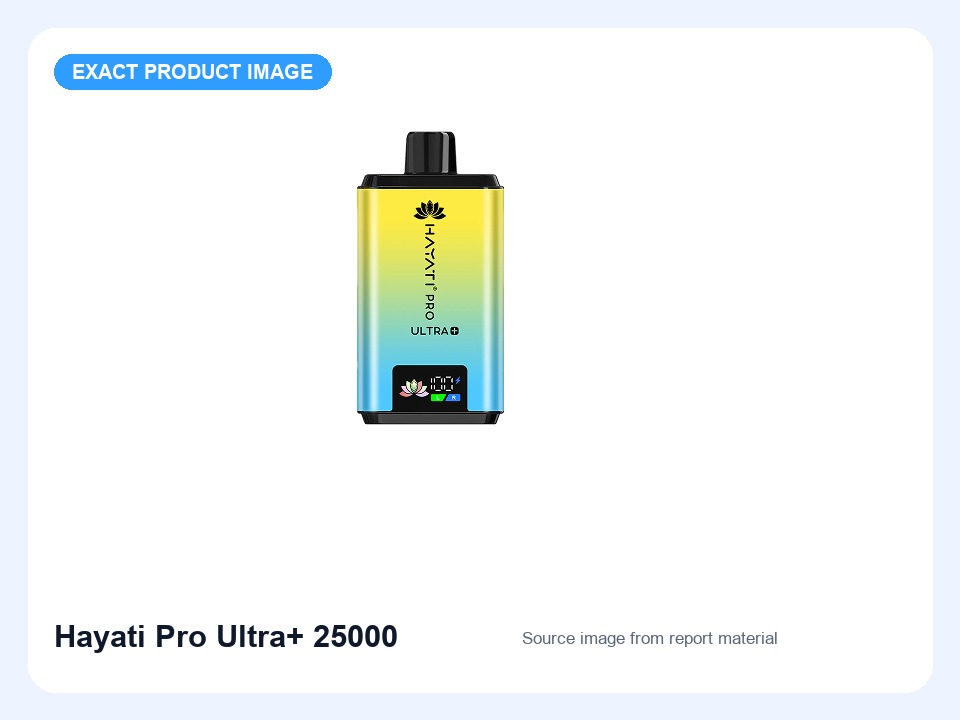
The five buyer questions this teardown answers
Is the “double tank” real? Yes. The system contains two separate auxiliary reservoir modules and two atomizer paths. Rotating the mouthpiece changes which side connects to the outlet, so the flavour-switching hardware is physical rather than a screen effect.
Does each flavour have a fully independent air path? Not end to end. Each side has its own liquid feed and heating element, but the examined structure uses a shared internal air space around the board area. “Double independent coil” therefore describes the two heating paths more accurately than it describes the whole airflow route.
Why might one side feel weaker? On this unit, the two sides were close but not identical: draw resistance was about 389 Pa on one side and 405 Pa on the other, while activation-flow readings were about 18 and 17.5 mL/s. The structure notes also identify side-wick contact as a possible feed variable. These are possible hardware factors, not a diagnosis of every weak-side complaint.
Why can vapour feel weaker before the battery display reaches zero? Output is not held at one flat power level across the full battery range. The bench data fell from about 12.75 W at 4.2 V to 9.8 W at 3.4 V, so a softer draw at lower battery voltage has a plausible electrical explanation.
Does the teardown prove 25,000 puffs? No. It confirms the high-capacity dual-reservoir architecture, but puff totals depend on draw duration, power, liquid delivery and the point at which the user stops. No standardised puff-count test was run.
Claim check: what the hardware confirms
| Hayati claim or buyer question | What we found in the unit examined | Evidence boundary |
|---|---|---|
| 25,000+ puffs | High-capacity, dual-reservoir and rechargeable architecture is present | Manufacturer claim only; no standardised puff test |
| “Pioneer Double Tank” | Two auxiliary reservoirs and two atomizer paths | Hardware confirmed |
| “Double Independent Coil” | Two left/right heating paths, with separate control tests for the selected side | Heaters are separate; the complete airflow route is not fully isolated |
| 850 mAh battery | A single 17350-format cell marked 850 mAh | Marked/rated value; no independent capacity-discharge test |
| Flavour switching | Rotating mouthpiece physically selects the left or right path | Hardware confirmed |
| Smart display | Display shows battery state and the selected L/R side | Display behaviour observed; it is not proof of exact remaining liquid |
What is actually inside the Hayati Pro Ultra Plus 25000?
The teardown separates into four functional groups: the rotating mouthpiece, the dual reservoir and atomizer assembly, the board-and-cell module, and the outer structure. The numbered image below shows 38 parts from the unit examined.
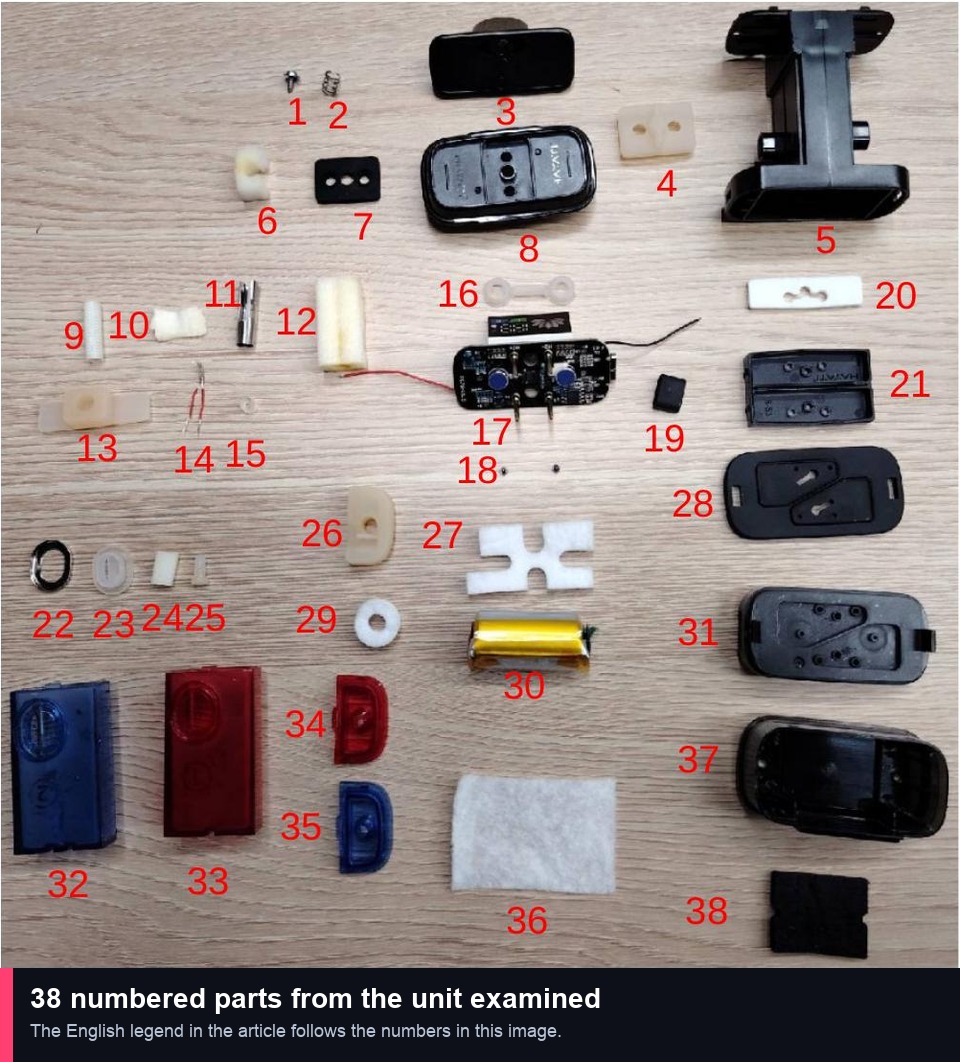
Complete component legend
| No. | Component | No. | Component |
|---|---|---|---|
| 1 | Phillips-head screw | 20 | Bottom absorbent cotton, pair |
| 2 | Mouthpiece spring | 21 | Reservoir-cup base |
| 3 | Rotating mouthpiece | 22 | Stainless-steel sleeve, pair |
| 4 | Upper liquid-blocking silicone | 23 | Side liquid-blocking silicone, pair |
| 5 | Reservoir cup / central frame | 24 | Side liquid-guide cotton, pair |
| 6 | Mouthpiece absorbent cotton, pair | 25 | Silicone plug, pair |
| 7 | Mouthpiece sealing silicone | 26 | Auxiliary-reservoir liquid-blocking silicone, pair |
| 8 | Mouthpiece cover | 27 | Board absorbent cotton |
| 9 | Glass-fibre tube, pair | 28 | Bracket sealing silicone |
| 10 | Inner wrap cotton, pair | 29 | Cell-tab absorbent cotton, pair |
| 11 | Steel tube, pair | 30 | 17350-format cell |
| 12 | Storage cotton, pair | 31 | Internal bracket |
| 13 | Lower liquid-blocking silicone, pair | 32 | Left auxiliary reservoir |
| 14 | Mesh heating element, pair | 33 | Right auxiliary reservoir |
| 15 | Atomizer fixing seat, pair | 34 | Right reservoir cover |
| 16 | Draw-activation sensor seal | 35 | Left reservoir cover |
| 17 | PCBA assembly | 36 | Cell absorbent cotton |
| 18 | Self-tapping screws, pair | 37 | Outer base |
| 19 | USB-C sealing silicone | 38 | Base absorbent cotton |
The legend translates the component names used in the supplied teardown material. “Pair” means the report lists two pieces for the left/right architecture.
How the rotating dual-tank system works
The top selector is more than a cosmetic dial. A spring-loaded rotating mouthpiece sits above the central reservoir frame. Turning it aligns the outlet with either the left or right atomizer path. Each side has its own auxiliary reservoir, liquid-blocking silicone, side liquid-guide cotton, storage cotton and mesh heater.
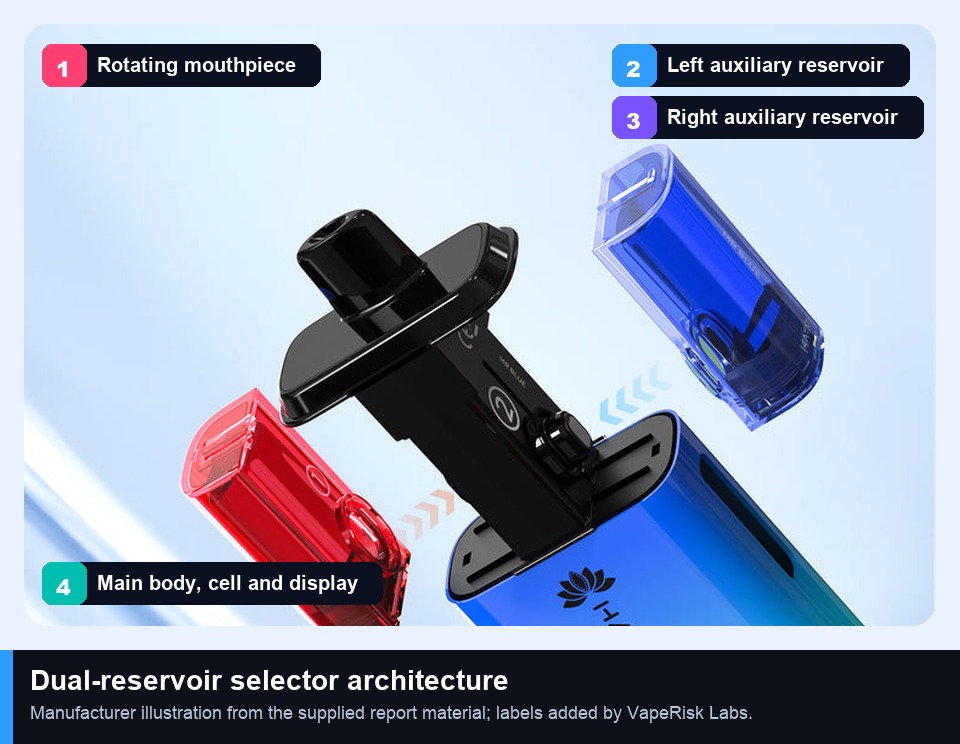
That explains why the product can switch flavours without electronically blending them: the selection is primarily mechanical. It also explains why installation and alignment matter. The structure notes describe left/right anti-misassembly ribs and matching side marks, but the reservoir module still relies on multiple contact and seal points to move liquid into the selected storage cotton.
Can Hayati Pro Ultra Plus pods be manually refilled?
The product’s public “refill” language can be confusing. The architecture uses replaceable or replenishing reservoir modules that feed the internal atomizer path; this teardown does not establish that the sealed modules are intended for users to open and fill with arbitrary e-liquid. Treat instructions that puncture, pry open or modify a pod as third-party modification rather than a function verified by this report.
Liquid feed, one-side weakness and burnt-taste complaints
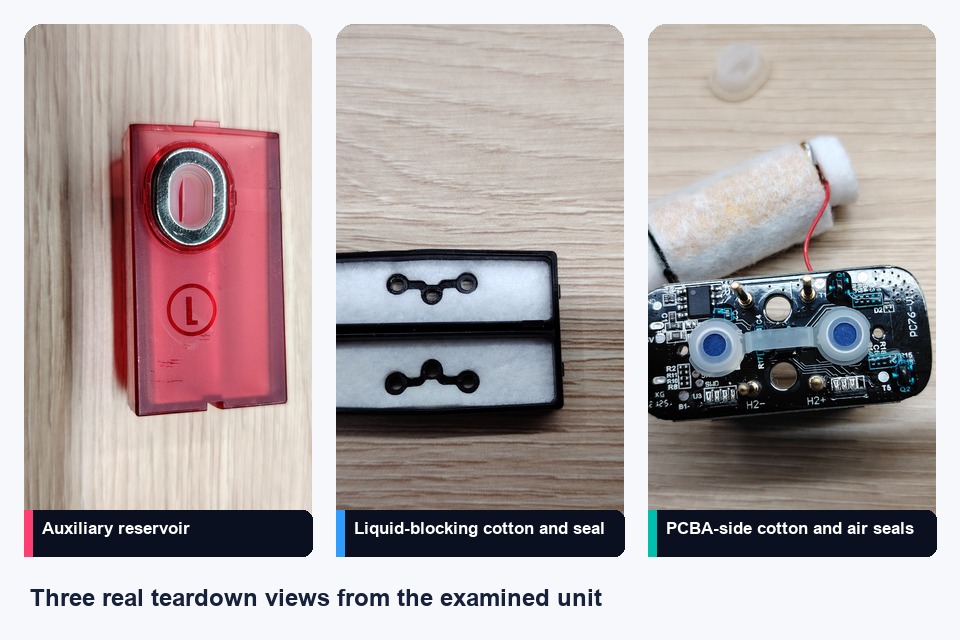
The most buyer-relevant structure detail is the side liquid-guide cotton. It has to remain in contact with the storage cotton so liquid can reach the selected mesh. The report flags imperfect contact or assembly position as a possible reason for slower feeding on one side. That does not prove that every “one flavour stopped working” or “burnt taste” complaint has the same cause, but it gives those complaints a testable hardware hypothesis.
The two measured sides were close:
| Side-to-side check | Side A | Side B | What it means |
|---|---|---|---|
| Draw resistance | ~389 Pa | ~405 Pa | Small difference on the unit examined |
| Activation-flow reading | ~18 mL/s | ~17.5 mL/s | Similar triggering, not perfectly identical |
If one side is completely dead, first rule out seating, selector alignment and an empty or poorly feeding reservoir. If both sides gradually feel softer as the battery runs down, the output curve below is the more relevant clue.
The output is not flat across the battery range
At a high battery voltage, the report records about 12.75 W at 4.2 V. At 3.8 V, output is about 12.18 W. By 3.4 V, it falls to about 9.8 W. Below roughly 3.3 V, the unit stops output and shows a low-battery state.
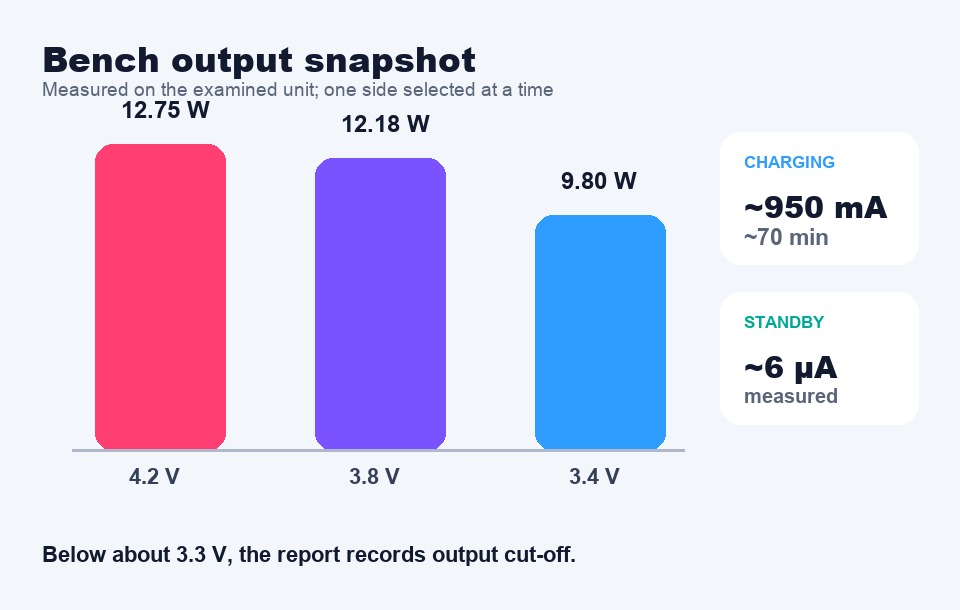
This does not make the product defective. It means the user should not expect exactly the same power at every point in the charge cycle. The measured heater waveform runs at about 119 Hz PWM, and the selected side is powered individually rather than both coils firing together.
Airflow and condensation: shared space matters
The air route begins at the bottom inlets, passes the bracket’s restriction and the air-sensor area, then reaches the selected atomizer. The structure report explicitly records no fully independent air channel: part of that internal route is formed by the housing around the board.
That matters for two reasons:
- Condensation is not automatically a reservoir leak. Vapour can cool in the mouthpiece and shared internal cavity, producing moisture even when a reservoir seal has not failed.
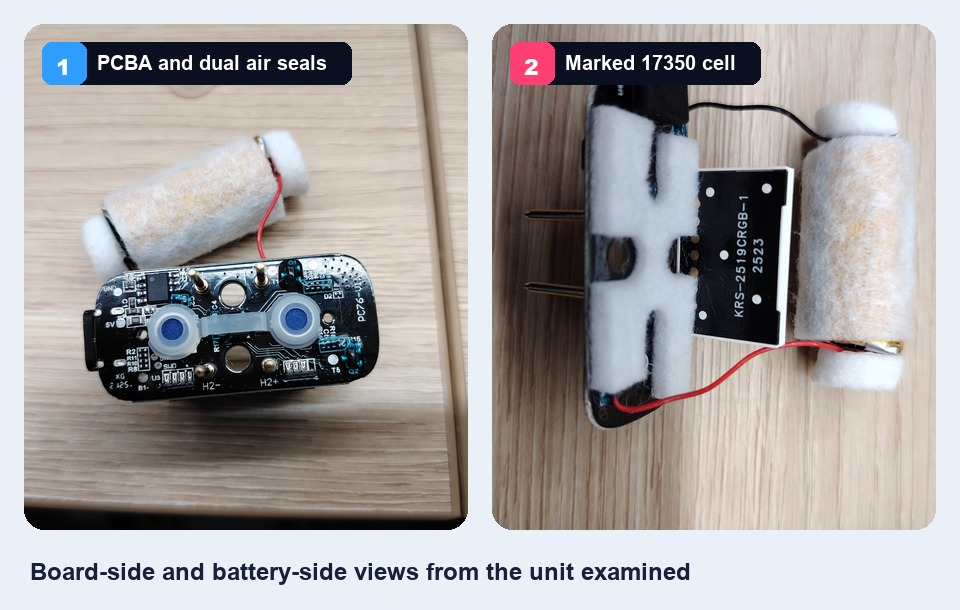
- Moisture control depends on cotton and seals around the board area. The examined unit includes board absorbent cotton, cell absorbent cotton, USB-C sealing silicone and dual air-sensor seals. Their presence describes this unit’s construction; it is not a brand-wide safety rating.
Battery, charging and standby
The cell is a 17350-format unit marked 850 mAh. We are treating that as a marked specification because the available teardown work did not include an independent full capacity-discharge result.
Bench charging was approximately 950 mA in the constant-current phase, with a reported full-charge time of about 70 minutes. Standby current measured about 6 µA, so idle electronics draw is low. These figures apply to the unit examined and do not predict the condition of a damaged cable, contaminated port or worn cell.
What this teardown says about the 25K pitch
The hardware does support the idea of a long-use, rechargeable, dual-reservoir product:
- two auxiliary reservoirs and two atomizer paths;
- a mechanically selected flavour side;
- a rechargeable cell marked 850 mAh;
- separate left/right heating paths;
- a display for battery and selected side.
But none of those converts into a verified puff count. A real 25,000-puff result would require a declared puff duration, interval, airflow, cut-off rule and endpoint, repeated across multiple units. We did not run that protocol, so 25,000 remains Hayati’s manufacturer claim.
What this teardown cannot prove
- A real-world total of 25,000 puffs
- The exact usable liquid volume of a retail unit
- The independently tested usable capacity of the 850 mAh-marked cell
- That every production unit has the same draw, seal performance or output
- The cause of every weak-vapour, burnt-taste, leaking or charging complaint
- Long-term coil life across flavours and user behaviour
How we examined this unit
VapeRisk Labs disassembled a Hayati Pro Ultra+ to component level, photographed the parts, reviewed the liquid and airflow paths, and recorded electrical behaviour on the bench. Findings describe the specific unit examined. Manufacturer statements are labelled as claims; observed or bench-recorded figures are labelled marked, measured or reported according to the evidence available.
FAQ
How does the Hayati Pro Ultra Plus dual-tank system work?
The unit examined has two auxiliary reservoirs and two selectable heating paths. A spring-loaded rotating mouthpiece mechanically aligns the outlet with the left or right flavour path, so one side is selected at a time.
Can you manually refill Hayati Pro Ultra Plus pods?
This teardown confirms replaceable or replenishing reservoir modules feeding the internal atomizer paths. It does not establish that users are intended to pry open, puncture or fill the sealed modules with arbitrary e-liquid; those are third-party modifications rather than a verified product function.
Does the Hayati Pro Ultra Plus really deliver 25,000 puffs?
25,000+ is Hayati’s manufacturer claim. VapeRisk Labs did not run a standardised puff test, so this teardown confirms the dual-reservoir hardware behind the pitch but not a measured puff total.
Why might one Hayati Pro Ultra Plus flavour side feel weaker?
On the unit examined, the two sides had slightly different draw and activation readings, and the structure report flagged side liquid-guide cotton contact as a possible feed variable. Seating, selector alignment and reservoir condition can also matter; this is not a diagnosis of every weak-side complaint.
Why can vapour output feel weaker as the battery runs down?
The recorded output fell from about 12.75 W at 4.2 V to about 9.8 W at 3.4 V. That means the device does not hold one flat power level over the whole battery range, so a softer draw at lower charge has a plausible electrical explanation.
Is moisture around the mouthpiece always a leak?
No. Condensation can form when vapour cools in the mouthpiece and shared internal air space. A reservoir leak involves liquid escaping its intended storage or feed path; the two should not be treated as the same observation.
What battery is inside the Hayati Pro Ultra Plus 25000?
The unit examined used a 17350-format rechargeable cell marked 850 mAh. The marking was observed, but this teardown did not independently measure the cell’s usable capacity.
What is inside the Hayati Pro Ultra Plus 25000?
The teardown found a rotating mouthpiece, two auxiliary reservoirs, two storage-cotton and mesh-heater paths, multiple liquid-blocking seals, a display and PCBA, and a 17350-format rechargeable cell. The full 38-part legend appears above.