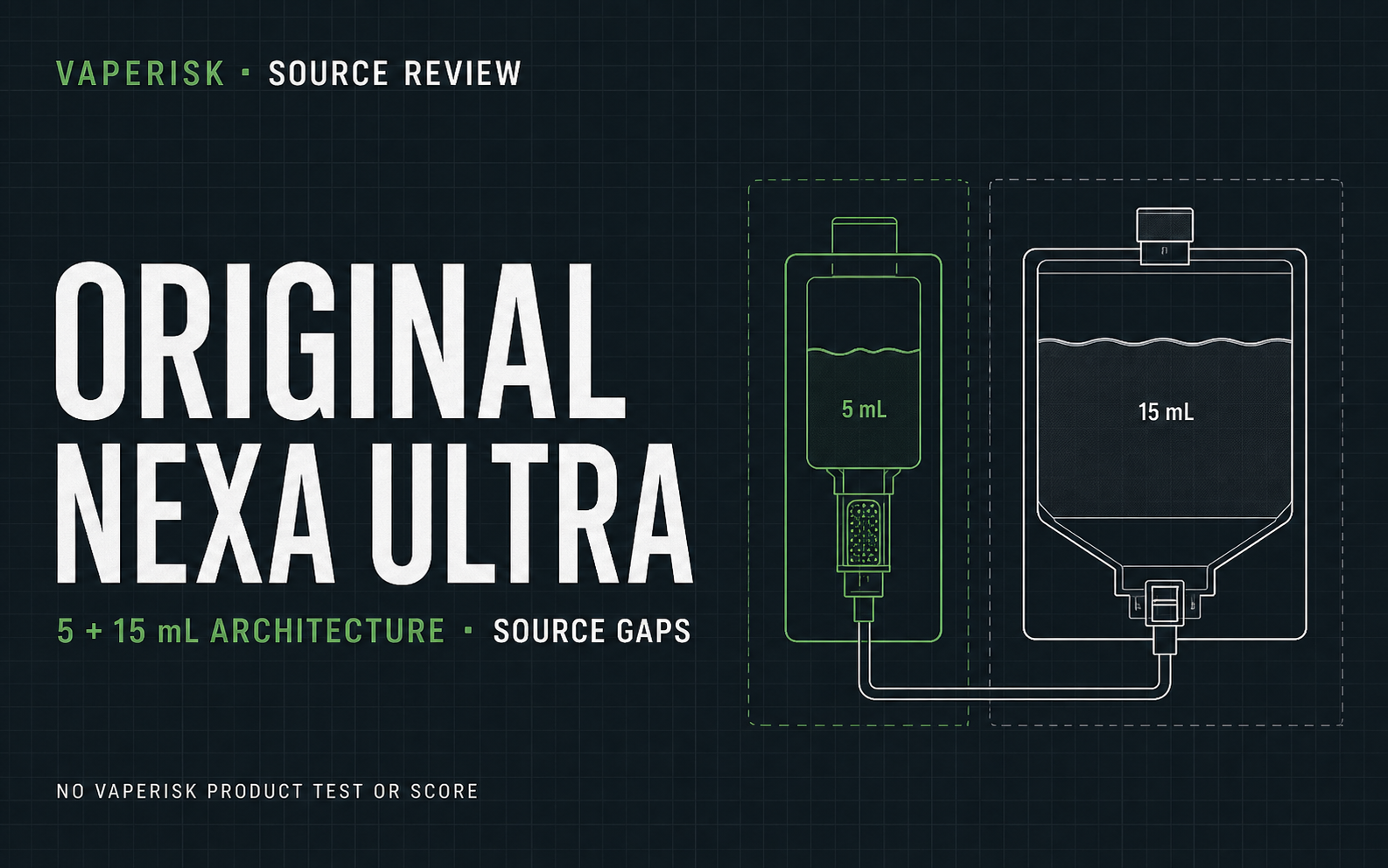
Quick answer: This page covers the original NEXA Ultra, not NEXA Ultra II or the InvisaCloud edition. Nexa’s current product page describes a two-part device with a 5 mL integrated prefilled pod, a separate 15 mL e-liquid container, Clarilock Structure, a Crystal Tank and a 3D curved screen. It carries a 50,000-puff headline, but the page does not disclose a test protocol and VapeRisk has not measured puff life or product performance.
This is a source-led product record, not a hands-on or laboratory review. It separates what the exact manufacturer page states from fields that remain unknown. That distinction matters because search results and retailer listings often blend the original Ultra with Ultra II.
Original NEXA Ultra at a glance
| Field | Current evidence | VapeRisk boundary |
|---|---|---|
| Exact model | NEXA ULTRA | Do not substitute Ultra II or InvisaCloud fields |
| Liquid structure | 5 mL integrated prefilled pod plus 15 mL e-liquid container | Manufacturer specification |
| Named structure | Clarilock Structure and Crystal Tank | Manufacturer terminology, not a measured performance result |
| Display | 3D curved screen | Manufacturer specification |
| Puff headline | 50,000 puffs | Manufacturer claim; method and expected personal result are not established |
| Package record | One device and a user manual | The page does not provide the manual text |
| Battery, charging and coil | Not stated on the exact current page reviewed | Left unknown |
| Nicotine strength and market SKU | Not stated on the exact current page reviewed | Left unknown; verify the exact pack and market |
What the official page establishes
The useful part of the original Ultra record is its architecture. Nexa lists a 5 mL integrated prefilled pod together with a 15 mL e-liquid container. It also names Clarilock Structure, Crystal Tank, Flavor Booster and a 3D curved screen. Those labels identify the product and help readers check whether a listing shows the correct version.
The page also says the design maximizes liquid efficiency and promotes up to 35% more puffs. That is manufacturer marketing. The page captured for this record does not publish the comparison group, sample count, draw duration, activation interval or independent result. VapeRisk therefore reports the language without converting it into a measured advantage.
What the page does not establish
The exact original Ultra page reviewed here does not state battery capacity, charging port, charging procedure, coil or resistance, nicotine strength, Normal/Turbo modes, airflow behavior, leakage performance, flavour result, vapour result or real-world runtime. Those fields remain unknown on this record.
Secondary pages may display values for related NEXA models, but family resemblance is not enough. Ultra II has its own official specification set, including a different liquid split and mode language. Moving those values onto the original Ultra would make the page easier to read but less accurate.
How to interpret the 50,000-puff headline
The current product page carries a 50,000-puff headline. It does not publish a traceable puff-count method on the page used here. Puff totals can depend on draw length, activation pattern, power behavior, liquid delivery and device condition. For that reason, the headline should be read as a manufacturer claim rather than a promise about an individual device.
VapeRisk has not tested a sample of the original Ultra and does not assign it a numeric score. See the Claimed vs Measured dataset and Battery Capacity vs Puff Count for the method used when a traceable sample and measurements are available.
Version check: original Ultra versus Ultra II
The safest identity check is the combination of product name and architecture. The original Ultra record uses a 5 mL integrated prefilled pod plus 15 mL container and names Clarilock and a 3D curved screen. Ultra II instead has its own 4 mL plus 16 mL structure, 900 mAh battery and Light/Dark mode record.
Use the NEXA Ultra versus Ultra II comparison when a listing mixes those fields. The comparison reports manufacturer statements and does not declare a performance winner.
Before relying on a listing
- Match the exact model name to the official product page.
- Check that the liquid split and named structure belong to the same model.
- Do not infer battery, charging, coil or nicotine fields from another Ultra-family page.
- Use Nexa’s official verification page and keep the seller, invoice and packaging record.
- Check the exact product and current rules in the destination market.
A verification result can help establish authenticity. It does not prove product condition, market authorization, puff life or performance.
Evidence status
- Source type: exact current manufacturer product page.
- Page reviewed: July 15, 2026.
- VapeRisk sample: none.
- Hands-on or bench method: none.
- Numeric VapeRisk rating: none.
- Open evidence request: version-matched manual, charging and component documentation, a traceable sample, and permission for reusable product media.
Sources
- NEXA Ultra official product page, reviewed July 15, 2026.
- Nexa official product verification, reviewed July 15, 2026.
Nexa, a retailer or another evidence holder may supply exact documentation or a traceable sample under VapeRisk’s evidence rules. No contributor can buy a rating, winner, puff verdict, market-status conclusion or editorial outcome. See our Sponsorship Standards.
FAQ
Is this page about the original NEXA Ultra?
Yes. It covers the original NEXA Ultra product page and does not import specifications from Ultra II or InvisaCloud.
What liquid capacity does the original NEXA Ultra list?
Nexa lists a 5 mL integrated prefilled pod plus a separate 15 mL e-liquid container.
Does the original NEXA Ultra page state a battery capacity?
No battery capacity is stated on the exact current original Ultra page reviewed for this record.
Does it have Normal and Turbo modes?
The exact current original Ultra page reviewed here does not publish a Normal/Turbo split or control procedure. Those Ultra II fields are not applied to this model.
Does NEXA Ultra really deliver 50,000 puffs?
Nexa publishes a 50,000-puff headline. VapeRisk has not measured the device, and the page does not disclose a traceable test protocol, so the figure remains a manufacturer claim.
What charging port, coil and nicotine strength does it use?
Those fields are not stated on the exact current original Ultra product page reviewed here and remain unknown on this record.
How is the original Ultra different from Ultra II?
The original page lists a 5 mL plus 15 mL structure, Clarilock and a 3D curved screen. Ultra II has a separate 4 mL plus 16 mL, 900 mAh and Light/Dark mode record.