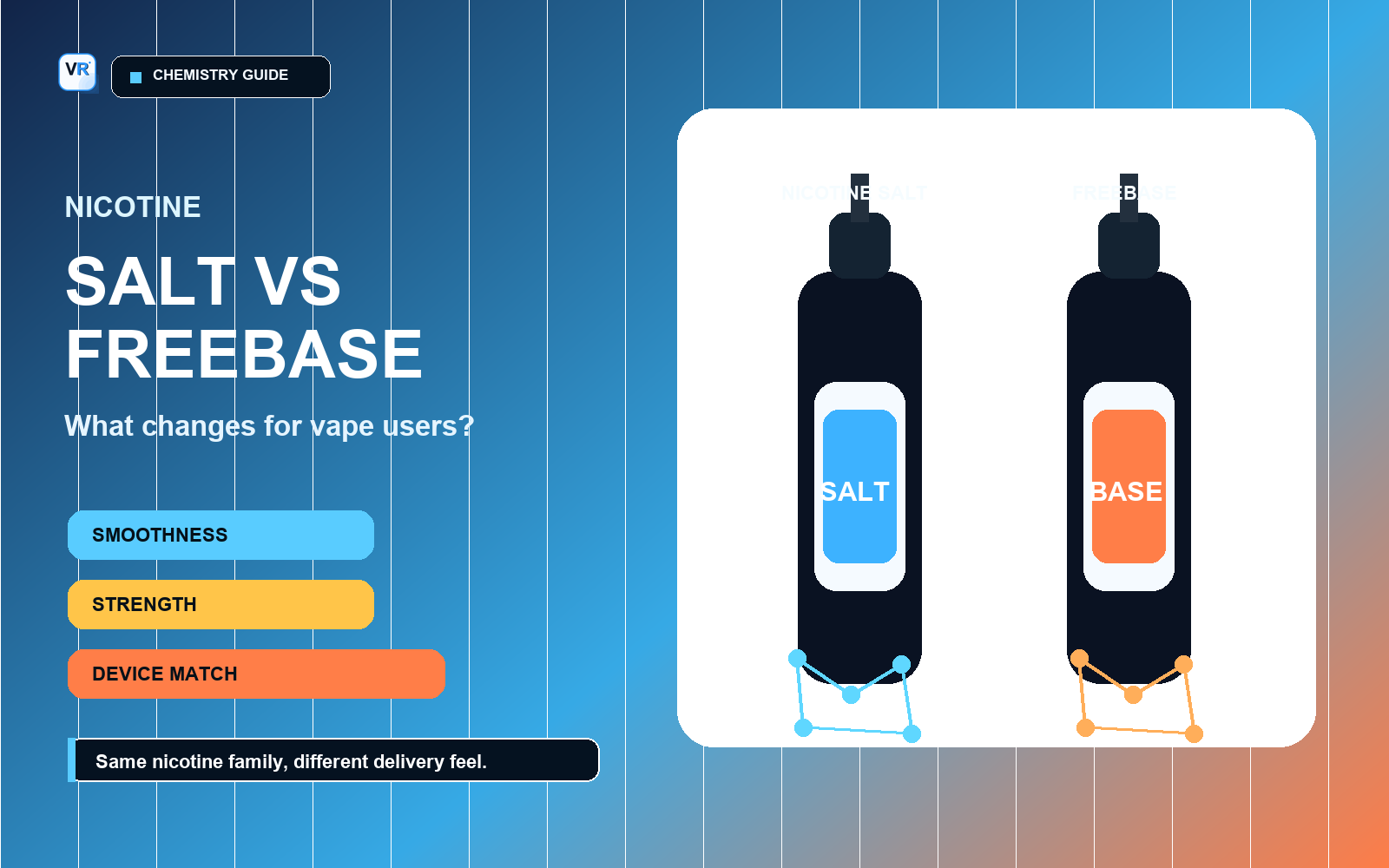
Quick answer: Nicotine salt and freebase nicotine describe different nicotine formulations in e-liquid. Nicotine salts are commonly paired with compact, lower-power pod devices and are often perceived as less harsh at higher labeled strengths. Freebase nicotine is common in lower-strength liquids and open-system devices, where the vapor, airflow, and power settings can be more adjustable. The label alone does not determine nicotine intake: concentration, device output, puff pattern, and the product’s instructions all matter.
What is the difference?
Freebase nicotine is the unprotonated form traditionally used in many e-liquids. Nicotine salt is nicotine formulated with an acid so the liquid has a different chemical profile. In practical product terms, the two labels describe formulation, not a guarantee of a particular device, flavor, or effect.
Both types contain nicotine when the label says they do. Nicotine is addictive, and a nicotine product is not risk-free. This page is for reading labels and comparing product design; it is not medical advice or a recommendation to start or continue vaping.
Strength and concentration: how to read the label
Nicotine strength is usually shown as milligrams per millilitre (mg/mL). The percentage is a mass-per-volume conversion: 20 mg/mL = 2%, 10 mg/mL = 1%, 5 mg/mL = 0.5%, and 3 mg/mL = 0.3%. For example, a 10 mL bottle labeled 10 mg/mL contains 100 mg of nicotine in the liquid before any use or wastage.
- Compare like with like: mg/mL and percentage express concentration, while a device’s vapor output affects how much liquid is aerosolized.
- Do not assume a 20 mg/mL salt liquid is equivalent to a 20 mg/mL freebase liquid in every device or puff pattern.
- Check whether a label uses mg/mL, percent, or a shorthand such as 20 mg. If the unit is unclear, use the manufacturer’s instructions or do not use the product.
- Keep nicotine liquid away from children and pets. Follow the package warning, storage instructions, and local disposal rules.
Device compatibility: pod, disposable, or open system?
Compatibility depends on the product specification, coil resistance, power range, airflow, and the liquid’s viscosity as well as its nicotine form. The common pattern is useful as a first filter, but it is not a rule for every product:
| Liquid pattern | Often seen with | What to check |
|---|---|---|
| Nicotine salt | Compact pods, prefilled pods, and many disposables | Device instructions, labeled strength, coil range, and whether the product is intended for refill use |
| Freebase nicotine | Open-system pods, tanks, and lower-strength e-liquid | Recommended wattage, coil resistance, PG/VG balance, airflow, and the liquid’s stated use |
A high-strength liquid in a high-output device can be an uncomfortable or unsuitable combination. A low-power pod may also perform poorly with a liquid that is too thick for its wicking design. Follow the device and liquid maker’s compatibility guidance rather than choosing by the word “salt” or “freebase” alone. Never mix an unfamiliar liquid with a closed or prefilled product.
Sensory differences: useful clues, not promises
Many users describe nicotine salts as smoother or less throat-irritating at higher labeled strengths, while freebase liquids are often described as having a more noticeable throat hit. Those are common sensory descriptions, not a guaranteed result. The feeling can change with acid choice, nicotine concentration, flavorings, PG/VG ratio, temperature, coil condition, airflow, and individual sensitivity.
Flavor intensity, cloud volume, and throat sensation are separate variables. A salt liquid is not automatically weaker, a freebase liquid is not automatically stronger, and a smoother sensation should not be interpreted as lower nicotine exposure or lower health risk.
Germany and EU context
For nicotine-containing electronic cigarettes and refill containers placed on the EU market, Article 20 of Directive 2014/40/EU sets a maximum nicotine concentration of 20 mg/mL, limits refill containers to 10 mL, and limits disposable electronic cigarettes, single-use cartridges, or tanks to 2 mL. The directive also requires child-resistant and tamper-resistant presentation and consistent nicotine dosing under normal use.
Germany implements these requirements through the Tabakerzeugnisgesetz, Section 14, which states the 20 mg/mL limit and the 10 mL and 2 mL volume limits for nicotine-containing products. Germany also requires product information and warnings under the surrounding provisions of that law. Member states can have additional rules, taxes, enforcement practices, or sales restrictions, so a product that appears compliant with the EU baseline still needs a Germany-specific check.
For a Germany-facing product, read the original packaging, nicotine warning, batch and manufacturer information, and instructions. The German Federal Office of Consumer Protection and Food Safety (BVL) explains the notification framework for e-cigarettes and refill containers. This page does not determine whether a particular brand, flavor, device, or import route is lawful.
Safety and compliance boundaries
- Nicotine liquids can be toxic if swallowed or absorbed through skin. Avoid contact, follow the label, and seek urgent local poison-control or emergency help after suspected exposure.
- Use only the liquid and device combination specified by the manufacturer. Stop using a leaking, damaged, overheating, or unexpectedly harsh product.
- Do not treat nicotine salt, freebase, “smooth,” “clean,” or “tobacco-free” language as a health claim. The U.S. FDA states that nicotine products are regulated and that adults who do not use tobacco products should stay tobacco-free.
- Keep products away from minors. Age, advertising, packaging, reporting, and retail rules differ by jurisdiction and can change.
Related VapeRisk pages
For a product-specific Germany example, see easyLiQ and the MAX pod system in Germany. For a different product architecture, see what a 0+10 vape is and the DOJO 0+10 teardown. These pages describe their own products or test observations and should not be generalized to every nicotine liquid or device.
For a separate U.S. nicotine-product status example, see FDA’s ZYN modified risk claim orders. ZYN is an oral nicotine pouch, not an e-liquid formulation or ENDS product, and that order covers specific products and marketing language rather than nicotine salt or freebase chemistry.
FAQ
Is nicotine salt stronger than freebase nicotine?
Not by definition. Strength is the labeled concentration, usually in mg/mL. Salt liquids are often sold at higher concentrations and can feel smoother, but the label, device output, and use pattern all matter.
Can nicotine salt liquid be used in any vape?
No. Use the device maker’s compatibility and power guidance. Many higher-strength salt liquids are designed for lower-power pod-style devices, while high-output tanks may require a lower-strength liquid.
What does 20 mg/mL mean?
It means the liquid is labeled as containing 20 milligrams of nicotine per millilitre, which is 2% by the usual mass-per-volume conversion. It does not predict the exact amount absorbed by a person.
Is freebase nicotine safer than nicotine salt?
This page cannot make that claim. Both are nicotine formulations, and risk depends on the full product, exposure, and use context. “Smoother” describes sensation, not safety.
What is the EU nicotine limit for e-liquid?
Under the EU Tobacco Products Directive baseline, nicotine-containing liquid may not exceed 20 mg/mL, with related container limits. Germany states the same limits in Section 14 of its Tabakerzeugnisgesetz. Always check current local rules and the product’s official labeling.
Last reviewed: 10 July 2026. Regulations and product specifications can change; official sources and the product label take priority.