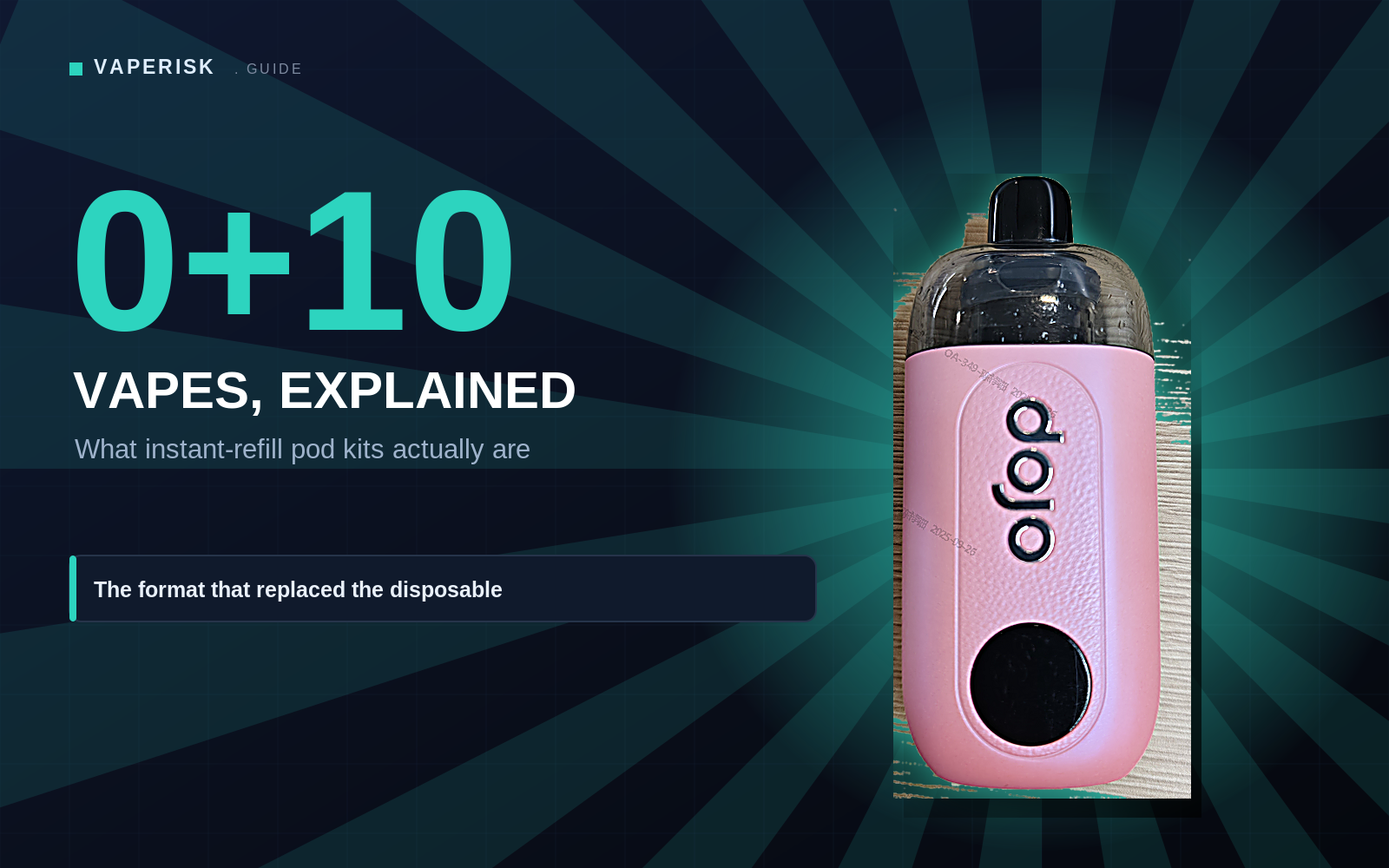
A plain-English guide to the 0+10 / 2 mL + 10 mL format: what the label usually means, how the parts fit together, and which UK/EU rules still matter.
Quick answer: A 0+10 vape usually means a reusable device architecture built around two separate parts: a pod or core that is dry or near-dry at first use, and a separate refill source that carries the e-liquid. In some products that split is close to a true 0 mL + 10 mL concept; in others the real retail format is better described as 2 mL + 10 mL, where a small pod or cartridge works with a separate refill container. The important buyer answer is that 0+10 is format shorthand, not a universal engineering standard. You still need to check whether the product is rechargeable, refillable, properly notified, within local nicotine-volume limits, and sold with compatible replacement parts.
What does 0+10 actually mean?
In shopper language, 0+10 usually points to a split-liquid design. The core device is sold separately from the main refill volume, so the user has to connect, insert, unlock, or otherwise activate the refill side before vaping. That is why many people also talk about the same family as 2 mL + 10 mL products: the real commercial format may be a small pod plus a separate refill container rather than a literally empty core.
The safest way to read the label is this: 0+10 tells you the product is trying to separate the device side from the refill side. It does not prove every product in the category uses the exact same internal path, the same amount of liquid in the first pod, or the same legal status in every market. Brand examples such as the Vaporesso DOJO 0+10 teardown, the Elf Bar MAX teardown, and the GRABIT easyLiQ / MAX Germany launch are useful for understanding the range, but none of them should be treated as universal proof for the whole category.
What the kit usually includes
- Battery device: the reusable body, usually rechargeable by USB-C or a dock.
- Pod, cartridge, or core: the section that contains the coil and the first liquid path.
- Separate refill source: often a 10 mL refill container in UK/EU-facing nicotine markets, or a proprietary refill cartridge designed only for that system.
- Replacement consumables: spare pods, cartridges, coils, or refill bottles that should be available separately if the product is genuinely reusable.
- Instructions: important because the activation method varies widely across brands.
How the refill or transfer workflow usually works
- Check the exact system first. Make sure the refill item matches the device family. Many 0+10-style kits use proprietary parts and are not cross-compatible.
- Connect or activate the refill side as instructed by the brand. Depending on the design, that may mean inserting a bottle, locking a refill cartridge into place, or opening the path between the refill side and the pod.
- Give the wick time to saturate. Fast activation does not mean the coil is ready instantly. If the core has not wicked properly, the first puffs can taste burnt.
- Start gently and stop if the device leaks, tastes burnt, or draws abnormally. Those are signs the liquid path, wick, or compatibility assumption may be wrong.
This is a format explanation, not a brand-specific operating manual. If a product only works with a named refill pod or cartridge, do not assume you can improvise a bottle transfer from another system.
Compatibility and safety limits
- Do not assume all 0+10 parts fit each other. Separately available refills are a legal/commercial requirement for reusable systems, not proof of cross-brand compatibility.
- Do not assume 0+10 always means open refillable. Some products are closer to fixed-combination or proprietary-pod systems than to open-tank refillables.
- Do not assume the 10 mL side is the only compliance question. Pod size, nicotine strength, notification status, packaging, and warnings still matter.
- Do not assume fast fill means no priming risk. A 0+10 device can still leak or taste burnt if the liquid path or wick is not working properly. See why vapes leak and why vapes taste burnt.
- Do not treat high-puff marketing as measured proof. Refill size and puff-count claims are not the same thing. Use our puff-claim framework and the battery capacity vs puff count analysis to sanity-check big numbers.
UK and EU regulatory context
The current UK context matters. According to official GOV.UK guidance, single-use vapes became illegal to sell or supply on 1 June 2025. GOV.UK also says a reusable vape must have a rechargeable battery, a refillable container, and a removable and replaceable coil if the product uses a coil. Refills such as pods or e-liquid refill bottles should be separately available to buy. That is why 0+10 and 2 mL + 10 mL systems have become more visible: they are trying to preserve disposable-style simplicity while fitting a reusable product definition.
But the reusable label is only part of the rule set. Official UK consumer-product guidance also says nicotine e-cigarette products sold to end consumers must keep the e-cigarette tank at 2 mL or below, keep a nicotine refill container at 10 mL or below, keep nicotine strength at 20 mg/mL or below, and be notified and published by the MHRA before sale. MHRA retailer guidance says that if you cannot locate the product on the published list, it should not be supplied. The EU Tobacco Products Directive framework uses the same 2 mL tank, 10 mL refill-container, and 20 mg/mL nicotine baseline, which is why this split-format architecture keeps appearing across Europe.
The result is a simple buyer rule: 0+10 can describe a compliance-led product architecture, but the label itself does not prove compliance. You still need the exact notified product, the correct refill item, the right nicotine strength, and a reusable hardware setup that matches the rules in the market where it is being sold.
Claim / Evidence / Risk table
| Claim | Evidence | Risk if you over-read it |
|---|---|---|
| 0+10 means the product is legal after the UK disposable ban | Official UK guidance says reusable products must be rechargeable, refillable, have replaceable coils if applicable, and have separately available refills. UK vape-product rules also still require 2 mL / 10 mL / 20 mg/mL limits and MHRA notification. | The format label alone does not prove the product is reusable, notified, or legal to supply. |
| 0+10 always means the first pod or core contains exactly 0 mL | Some systems are close to a true dry-core design, but adjacent 2+10 or fixed-combination products are marketed in very similar language. | You can misdescribe a 2 mL + 10 mL product as a pure 0+10 system when it is not. |
| Any 10 mL pod or bottle will work with any 0+10 device | Official reusable-vape guidance requires refill availability, not universal compatibility. Many systems use proprietary pods, refill cartridges, or lock-in geometry. | Wrong-part use can cause leaks, failed activation, poor wicking, or buyer confusion. |
| Instant refill means instant readiness | Activation can be fast, but the wick still has to saturate. The exact transfer path differs across brands and pods. | Using the device too soon can cause dry hits, burnt taste, or weak performance. |
| A 10 mL refill side proves high puff performance | 10 mL is a packaging/refill limit, not a verified lifetime result. Real puff outcomes depend on coil efficiency, power level, airflow, battery delivery, and user behavior. | You may mistake a legal-format number for measured performance evidence. |
FAQ
What does 0+10 mean on a vape?
It usually means the device side and the refill side are split. In practice, the buyer is dealing with a reusable system where the main refill volume sits outside the first pod or core and has to be connected or activated before use.
Is 0+10 the same as 2+10?
Not always. A true 0+10 description implies a dry or near-dry core plus a separate refill source. A 2+10 product usually has a small pod plus a separate refill container. The marketing language overlaps, so check the exact hardware.
Are 0+10 vapes legal in the UK after the disposable ban?
Not automatically. Since 1 June 2025, the UK only allows reusable vapes to stay on sale. A product still has to meet the reusable definition, the 2 mL / 10 mL / 20 mg/mL rules, and the MHRA notification requirements.
Do 0+10 products still have to follow the 2 mL, 10 mL and 20 mg/mL limits?
Yes for nicotine consumer products sold in the UK, and the EU framework uses the same baseline. The split format does not remove the tank, refill-container, nicotine-strength, packaging, or notification rules.
Can you use any pod or bottle with a 0+10 kit?
Usually no. Most systems are proprietary. Separately available refills are important, but that does not mean refills are universal across brands.
Why can a 0+10 vape still taste burnt?
Because the wick may not be fully saturated yet, the wrong refill part may be installed, or the liquid path may not be working properly. The format does not eliminate dry-hit risk.
Sources
- GOV.UK: Single-use vapes ban
- GOV.UK: E-cigarettes regulations for consumer products
- GOV.UK / MHRA: E-cigarette and vape advice for retailers and producers
- MHRA ECIG Dynamic Search
- EUR-Lex: Directive 2014/40/EU