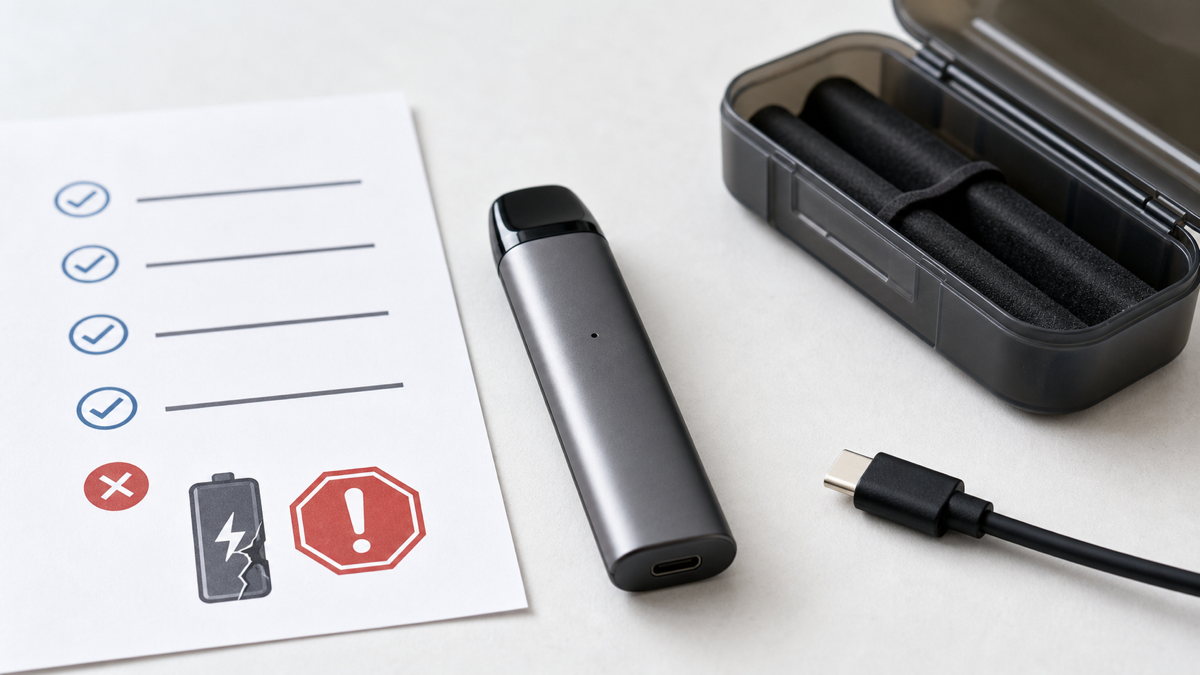
Quick answer: Check the device, battery area, charging port and instructions before use. Charge only as the manufacturer directs, on a clean flat surface that you can see and away from flammable material. Stop using or charging a device that is damaged, leaking, swelling, making an unusual sound or smell, becoming unusually hot, firing unexpectedly, or blinking while heat, damage or liquid is present. Do not put a discarded vape in household trash or curbside recycling.
This is a general U.S.-focused safety checklist, not a certification that any vape is safe. Device instructions, battery design, airline rules and local waste programs can differ. If a product is smoking, venting, burning or creating an immediate hazard, move away and contact local emergency services rather than trying to inspect or repair it.
Vape battery warning signs and the next step
| What you notice | What to do | What not to assume |
|---|---|---|
| Damaged casing, crushed body, loose port, swelling, leaking or exposed battery wrap | Do not use or charge it. Keep people away from the device and follow the manufacturer or local hazardous-waste route. | A device is not safe merely because it still turns on. |
| Unusual heat, odor, hissing, popping, smoke or a sudden charging change | Stop use. If there is smoke, fire or extreme heat, move away and call emergency services. Report a product problem after the immediate risk is controlled. | USB-C, a battery indicator or a protection label does not rule out failure. |
| Missing instructions or uncertain cable, adapter or replaceable-battery specification | Pause and ask the manufacturer for the exact model guidance before charging. | A connector that fits is not proof that the charging setup is appropriate. |
| No visible problem | Still follow the manual, charge where you can see the device and protect it from extreme temperatures. | A clean appearance is not a safety certification or recall check. |
Before first use
- Match the exact product. Record the manufacturer, model, serial or batch information where available. Check the package and device against the official support page rather than relying on a marketplace listing.
- Read the charging instructions. FDA advises users to understand the manufacturer’s recommendations and contact the manufacturer when instructions are missing or unclear.
- Inspect the device. Look for shipping damage, a distorted body, liquid near the charging port, a loose port, torn external-battery wraps where applicable, or any sign that the device has been crushed or modified.
- Check removable batteries. Use only batteries recommended for the device. FDA advises against mixing brands, charge levels, or old and new batteries.
- Verify the seller record. Keep the receipt, model, source and product photos. VapeRisk’s retailer intake-file guide explains what a store should retain before stocking a new SKU, while the authenticity guide explains why an official code check is only one evidence step.
How to charge a vape more safely
FDA advises charging a vape on a clean, flat surface, away from material that can easily catch fire, and in a place where the device can be clearly seen. A couch, bed or pillow can trap heat and can also allow accidental activation. The agency also advises keeping devices out of extreme heat or cold and not charging them in extreme temperatures.
Use the cable, adapter, dock and battery configuration specified for the exact model. If the manual does not name a compatible input or the supplied charging information is unclear, contact the manufacturer. Do not improvise a repair, bypass a protection feature or assume that a higher-powered adapter is suitable because the plug fits. For no-light, blinking, slow-charge or charging-but-not-hitting symptoms, use the vape not charging decision guide.
What USB-C does and does not prove
USB-C describes a connector and charging interface. It does not, by itself, prove the quality of the cell, charging controller, cable, thermal protection, assembly or firmware. A rechargeable design can support more use cycles, but it does not verify a product’s puff-count claim or show that the device will remain safe through every charge.
For the evidence limits behind battery and endurance claims, use VapeRisk’s Battery Capacity vs Puff Count method guide and the Claimed vs Measured teardown dataset. Those pages separate manufacturer claims, component markings, observations and measured results; none treats a charging port as proof of a final puff total.
When to stop using or charging the device
Stop when the condition or behavior changes in a way the manufacturer does not describe: unusual heat, a new odor or sound, smoke, swelling, leakage near electronics, repeated charging errors, a loose port, a damaged body, unexpected firing, or a battery wrap that is torn on a removable cell. Blinking combined with heat, damage or liquid is also a stop-use condition. Do not keep charging to see whether the problem clears.
There is no universal surface-temperature number in the cited FDA guidance that turns every device into a safe or unsafe one. The correct comparison is the exact model’s instructions and its previous normal behavior. If a device is too hot to approach safely, smoking or venting, keep away and call emergency services. Once the immediate risk is over, preserve the product identity and purchase details for the manufacturer and any regulator report.
Can you bring a vape on a plane?
Quick answer for US flights: yes, but an electronic cigarette or vape must stay on your person or in carry-on baggage. TSA says it is not allowed in checked baggage. FAA also requires protection against accidental activation, keeps spare lithium batteries out of checked baggage, and does not permit charging the device or its batteries on board.
| Travel item | Carry-on or on your person | Checked baggage | Key condition |
|---|---|---|---|
| Electronic cigarette or vape | Allowed under current US guidance | Not allowed | Protect it from accidental activation and follow airline limits. |
| Spare lithium battery | Allowed within the applicable battery limit | Not allowed | Protect each battery and its terminals from short circuit. |
| Charging during the flight | Not permitted on board | Not applicable | Do not recharge the vape or its battery on the aircraft. |
This is US screening and dangerous-goods guidance, not a universal international rule. Check the current TSA carry-on entry, FAA PackSafe page, your airline, and the departure, connection and destination rules before travel. Do not travel with a damaged, defective or recalled battery.
Disposal: keep vapes out of household trash and recycling
EPA says e-cigarettes contain both nicotine and lithium batteries and should not go into household trash or curbside recycling. Batteries can be damaged by compactors and create fires during transport or at waste facilities. EPA recommends taking discarded e-cigarettes to a household hazardous-waste collection site and checking with the local solid-waste agency for available programs.
Do not dismantle a sealed device merely to separate its battery. Follow the manufacturer and local collection program for the product design you actually have. Retailers considering a take-back program need a separate operational and regulatory review; consumer drop-off guidance is not automatically a business collection authorization.
How to report a battery fire or product problem
FDA asks consumers to report vape fires, explosions and other undesired health or quality problems through the Safety Reporting Portal. Useful details include the manufacturer, brand, model and serial number; battery brand and model; seller; how the product was used; and whether it was modified. Add the date, photos, receipt and charging setup when they can be collected safely.
Keep four conclusions separate: a report does not prove a defect across every unit; a valid authenticity code does not prove safety; a market notification or authorization does not certify battery condition; and a single safe-looking charge does not prove long-term reliability. VapeRisk’s Compliance & Market hub explains how these evidence systems answer different questions.
Sources
- FDA: Tips to Help Avoid Vape Battery Fires or Explosions. FDA content current as of April 12, 2024; page checked July 15, 2026.
- FAA PackSafe: Electronic Cigarettes and Vaping Devices. Updated April 13, 2026; checked July 16, 2026.
- TSA: Electronic Cigarettes and Vaping Devices. TSA entry checked July 16, 2026.
- EPA: How to Safely Dispose of E-Cigarettes. Updated January 30, 2026; checked July 15, 2026.
FAQ
Can I leave a vape charging overnight?
Do not leave it charging unattended. FDA advises charging on a clean, flat surface away from things that can catch fire and in a place where you can clearly see the device. An overnight charge usually fails that visibility test.
Does USB-C mean I can use any charger?
No. USB-C describes the connector, not the complete charging specification. Follow the exact model’s manual or manufacturer support. If the required cable, adapter or input is unclear, pause before charging.
What should I do if a vape becomes unusually hot?
Stop using or charging it. Do not continue the charge to test it. If it is smoking, venting, burning or too hot to approach safely, move away and contact local emergency services rather than trying to handle or repair it.
Can I use a vape with a damaged or swollen battery?
No. Do not use or charge a device or removable battery that is damaged, swollen, leaking, crushed or has a torn external wrap. Follow the manufacturer and local hazardous-waste guidance for isolation and disposal.
Can you bring a vape on a plane?
Yes on US flights, but keep the vape on your person or in carry-on baggage, never in checked baggage. Protect the device from accidental activation, protect spare-battery terminals from short circuit, and do not charge the device or battery on board. Airline and destination rules may add restrictions.
Can I put a disposable vape in household recycling?
No. EPA advises against putting e-cigarettes in household trash or curbside recycling because they contain nicotine and lithium batteries. Use a household hazardous-waste collection route or ask the local solid-waste agency.