Quick answer: A vape can leak because condensed vapour collects in the airway, the wick receives more liquid than the coil can vaporise, a pod or refill is overfilled or mismatched, seals are worn or poorly seated, or heat and pressure move liquid through a weak point. A small film at the mouthpiece is not automatically the same as an active e-liquid leak. Persistent liquid, gurgling, liquid entering the mouth, or liquid near the charging port, electronics or battery area needs a more cautious response. Disconnect power and stop using or charging the device if leakage appears with heat, swelling, damage, odor, sound, sparks, smoke or unexpected firing.
Evidence disclosure: This guide combines published safety instructions with observations from VapeRisk teardowns. A teardown finding describes the inspected sample and design, not every unit in a product line. VapeRisk has not inspected your device and cannot confirm from an exterior photo whether the liquid is harmless condensation, e-liquid from a failed seal, or contamination that has reached electronics.
Why is my vape leaking? Start with what you can see
| What you see | Possible explanation | Safe exterior action | Stop-use trigger |
|---|---|---|---|
| A light film or droplets in the mouthpiece | Condensation in the vapour path, or early flooding | Keep the device upright, wipe only accessible exterior surfaces and check the exact instructions | Persistent liquid entering the mouth, worsening gurgling, damage or unusual heat |
| E-liquid from an air hole | Flooding, over-wicking, pressure change, overfill or a seal problem | Stop drawing on it, keep it upright and use the seller/manufacturer support route | Leakage that continues at rest or reaches electrical areas |
| Liquid around the pod or device base | Pod mismatch, poor seating, damaged seal, overfill or reservoir failure | Remove only user-removable parts as the exact instructions permit; do not open a sealed body | Cracks, swelling, a loose connector, liquid inside a sealed body or repeated leakage after correct assembly |
| Liquid near a USB port, dock contact or electronics | Condensation or active leakage may have reached an electrical path | Disconnect power and stop using or charging | Treat this as an escalation even if the exterior is wiped dry |
| Leak plus heat, odor, sound, smoke, sparks or unexpected firing | Possible battery, electrical or control-system hazard | Move away and contact emergency services if there is active smoke, fire or extreme heat | Immediate stop-use condition |
Condensation is not the same as an active leak
Vapour cools as it travels through the mouthpiece and airway. Some of it can condense back into droplets. A well-designed device gives that liquid a controlled path away from the draw sensor and electrical areas. A poor design may let it collect until it reaches the mouthpiece, air inlet or base.
Condensation is still worth managing because pooled liquid can become difficult to distinguish from an active leak. Keep the device upright, avoid extreme heat and inspect accessible exterior surfaces. Do not use a wet charging port. If droplets repeatedly return after the exterior is wiped, if the device gurgles, or if liquid is visibly moving out of a pod or reservoir, treat it as persistent leakage rather than dismissing it as normal condensation.
The main engineering causes of vape leaks
Condensation drainage
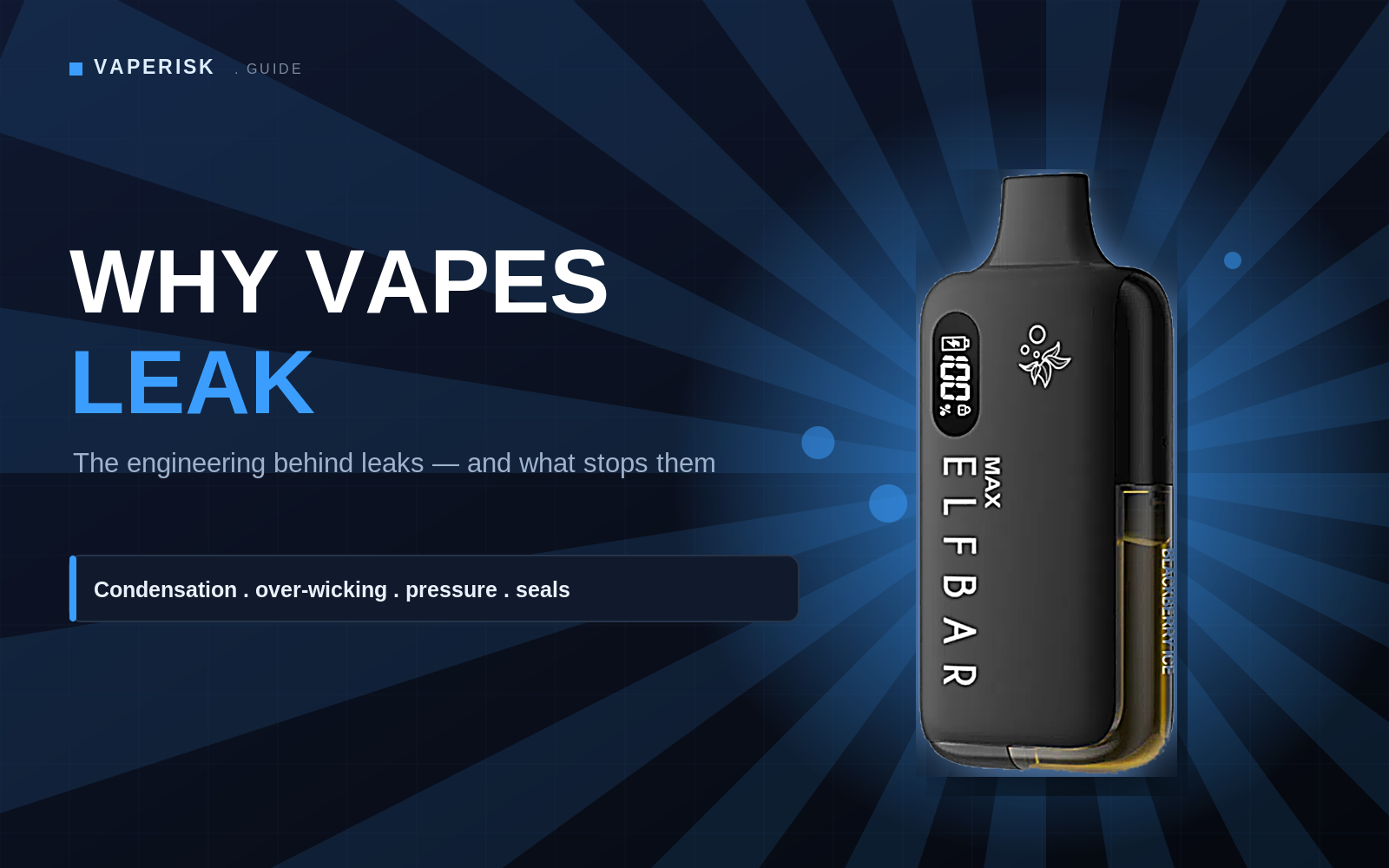
Airway geometry affects whether condensate is routed away or allowed to pool. In the VapeRisk Elf Bar MAX teardown, the inspected sample had a guide groove and cotton notch that appeared intended to route condensate away from the sensor. That is evidence about one inspected sample, not a guarantee that every unit will remain leak-free.
Over-wicking and flooding
A wick must feed liquid quickly enough to avoid a dry hit but not so quickly that the coil chamber floods. If liquid arrives faster than the coil can vaporise it, excess liquid can enter the airway and produce gurgling, spitback or leakage through air holes. Repeated hard draws, pressure-fed reservoir systems and a worn coil can all change that balance.
Overfill, pod mismatch and poor seating
Open-refill pods need the fill level, closure and air gap specified by the manufacturer. Closed or activation-refill systems depend on compatible parts and correctly seated seals. A pod that merely fits is not necessarily compatible. Do not force a pod, pierce a reservoir or improvise a seal.
Seal wear, cracks and pressure changes
O-rings, silicone seals, seams and reservoir walls can fail or shift. Heat can expand air and liquid inside a device, while altitude and transport can alter pressure across a seal. A hot car, direct sun, crushing in a bag or a cracked pod can turn a marginal seal into an active leak. Storage technique can reduce ordinary exposure, but it cannot repair a damaged reservoir or failed seal.
Leak location changes the decision
Liquid in the mouthpiece or mouth
Stop drawing on the device. Wipe only the accessible exterior and mouthpiece surfaces as the manufacturer permits. Do not blow liquid deeper into the device, inhale repeatedly to clear it, or insert tools into the airway. Persistent spitback or liquid in the mouth can indicate flooding, a failed seal or a damaged pod and warrants replacement or support.
Liquid from the air holes
Air-hole leakage often points to a flooded coil chamber, excess liquid in the airway or a pressure/seal problem. Keep the device upright and stop using it while you identify the exact model and instructions. If leakage continues while the device is resting, or returns after correct user-removable parts are seated, do not keep cycling, shaking or drawing on it.
Liquid around the pod or bottom
Check only user-removable components that the official instructions tell you to remove. Look for a cracked pod, damaged gasket, incorrect cartridge, overfill or a closure that is not seated. Do not disassemble a sealed disposable, separate a battery cell, glue a crack, add improvised packing material or bypass a contact.
Liquid near a charging port or electronics
Disconnect power and stop using or charging the device. Wiping the outside does not prove that the inside is dry or undamaged. Use the vape not charging decision guide for the charging boundary and the battery safety checklist for heat, swelling, damage, smoke, sparks, odor, sound and unexpected firing.
Safe, non-invasive steps
- Stop charging and identify the source. Do not connect power while liquid is near the port, contacts or electronics.
- Record the exact product. Keep the model, version, pod or reservoir name, seller, receipt and batch information.
- Keep it upright at room temperature. Move it away from heat and direct sun without squeezing, puncturing or opening it.
- Wipe only accessible exterior surfaces. Follow the exact manufacturer’s cleaning instructions. Do not push tools or absorbent material into a port, airway or sealed body.
- Check user-removable parts only. If the manual allows pod removal, inspect for a crack, mismatch, overfill or poor seating. Do not force parts.
- Stop the troubleshooting loop. A persistent leak, repeated gurgling or liquid that returns at rest belongs with the seller, manufacturer or warranty route.
What not to do with a leaking vape
- Do not charge it while the port, contacts or surrounding area are wet.
- Do not open a sealed body, remove a cell or bypass protection.
- Do not scrape contacts, lift pins, insert metal or probe an airway or port.
- Do not heat-dry, puncture, squeeze, glue or tape over a failed reservoir.
- Do not keep puffing to clear liquid from the coil.
- Do not assume that a wiped exterior proves the electronics are dry or safe.
What VapeRisk teardowns can and cannot show
The Vaporesso DOJO 0+10 teardown documented anti-leak cotton and a liquid path in the inspected sample, illustrating how reservoir pressure and wick geometry can work together or compete. The IVG Air 2-in-1 teardown adds another architecture example. These reports help buyers compare drainage, seals, reservoir paths and serviceability. They do not diagnose a reader’s device, establish a product-wide failure rate or replace a recall, warranty or regulator notice.
When to stop using the device
Stop using and charging when leakage is persistent, reaches the charging port or electronics, appears with a cracked or swollen body, or is accompanied by unusual heat, odor, sound, sparks, smoke or unexpected firing. Do not handle an actively smoking or burning device to collect photos. Move away and contact local emergency services when needed.
Keep the packaging, receipt, seller information and photos that can be taken without approaching a hazard. Report the problem to the manufacturer or seller. In the United States, relevant product incidents can also be reported through FDA’s Safety Reporting Portal or CPSC’s SaferProducts.gov.
Sources
- FDA: Tips to Help Avoid Vape Battery Fires or Explosions – manufacturer instructions, charging conditions and incident reporting.
- CPSC warning on separated loose lithium-ion cells – boundary against opening battery packs or improvising cells.
- GEEKBAR HERO user instructions – a model-specific example that addresses leakage, charging and no-tampering; not a universal rule for other products.
VapeRisk may consider evidence-led partnership proposals for leak-control research, teardown access or retailer quality systems, but no partner can buy a diagnosis, safety conclusion, ranking or editorial outcome. See our Sponsorship Standards and partnership formats.
FAQ
Why is my vape leaking from the bottom?
Possible causes include a cracked or poorly seated pod, overfill, a failed seal, reservoir pressure or flooding. Keep it upright, stop charging, inspect only user-removable parts allowed by the exact instructions and use support if the leak persists.
Why is vape juice coming through the mouthpiece?
Liquid in the mouthpiece can be pooled condensation, flooding or a wick and seal problem. Stop drawing on it, wipe only accessible exterior surfaces and do not blow, probe or keep puffing to clear it. Persistent liquid needs replacement or support.
Why is my vape leaking from the air holes?
Air-hole leakage can indicate a flooded coil chamber, over-wicking, overfill, pressure change or a seal problem. Keep the device upright and stop using it while you check the exact model instructions. Do not open or modify a sealed device.
Is a leaking vape dangerous?
The risk depends on where the liquid is and whether damage, heat or electrical warning signs are present. Liquid near a charging port, electronics or battery area is a stop-use and no-charge condition. Heat, swelling, odor, sound, smoke, sparks or unexpected firing requires immediate escalation.
Can I charge a vape after wiping away a leak?
Not when liquid was in or near the charging port, contacts, electronics or battery area. A dry exterior does not prove the interior is dry or undamaged. Use the manufacturer or seller support route.
Does storing a vape upright stop leaks?
Upright storage can reduce ordinary pooling and pressure on some seals, but it cannot repair a crack, failed gasket, incompatible pod or bad reservoir design. A leak that persists at rest needs support or replacement.
Can I fix a leaking disposable vape?
Do not open, puncture, glue, tape, heat-dry or modify a sealed disposable. Limit action to the exact manufacturer’s exterior instructions, stop charging, preserve purchase evidence and use the seller, manufacturer or warranty route.