The Vozol Rave 40000 is sold like a party vape: 40K puffs, a 20 ml tank, dual power modes and a 270-degree light show. VapeRisk Labs opened one to see which parts are real hardware, which claims need context, and where buyers should pay attention.
Vozol Rave 40000 teardown: on the retail unit VapeRisk Labs opened, the 1,000 mAh cell, dual-coil modes and FPC display were present; the 20 mL label corresponded to about 18.5 mL estimated effective oil-holding. The 40,000-puff figure remains Vozol’s claim because no standardized puff-count test was run.
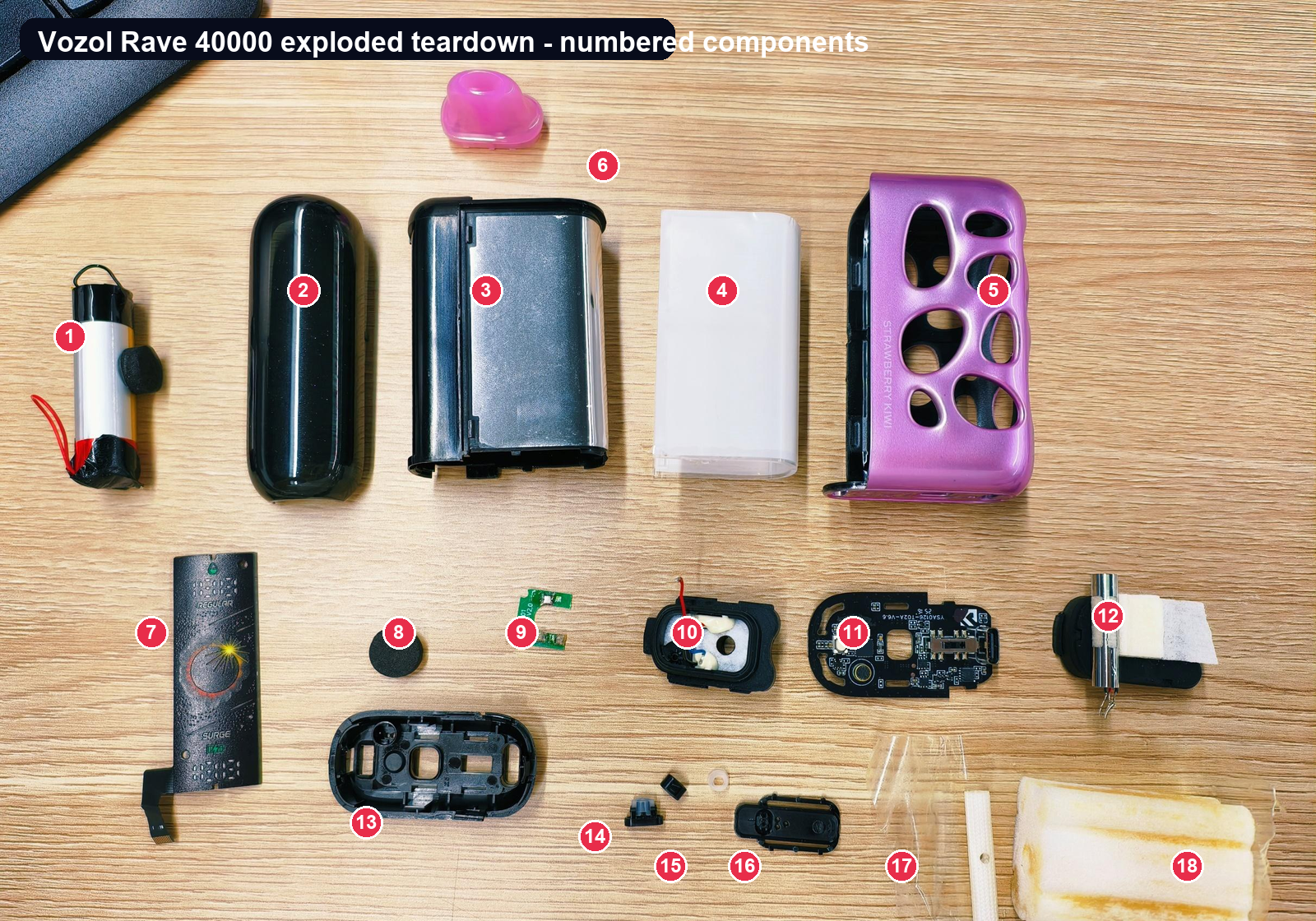
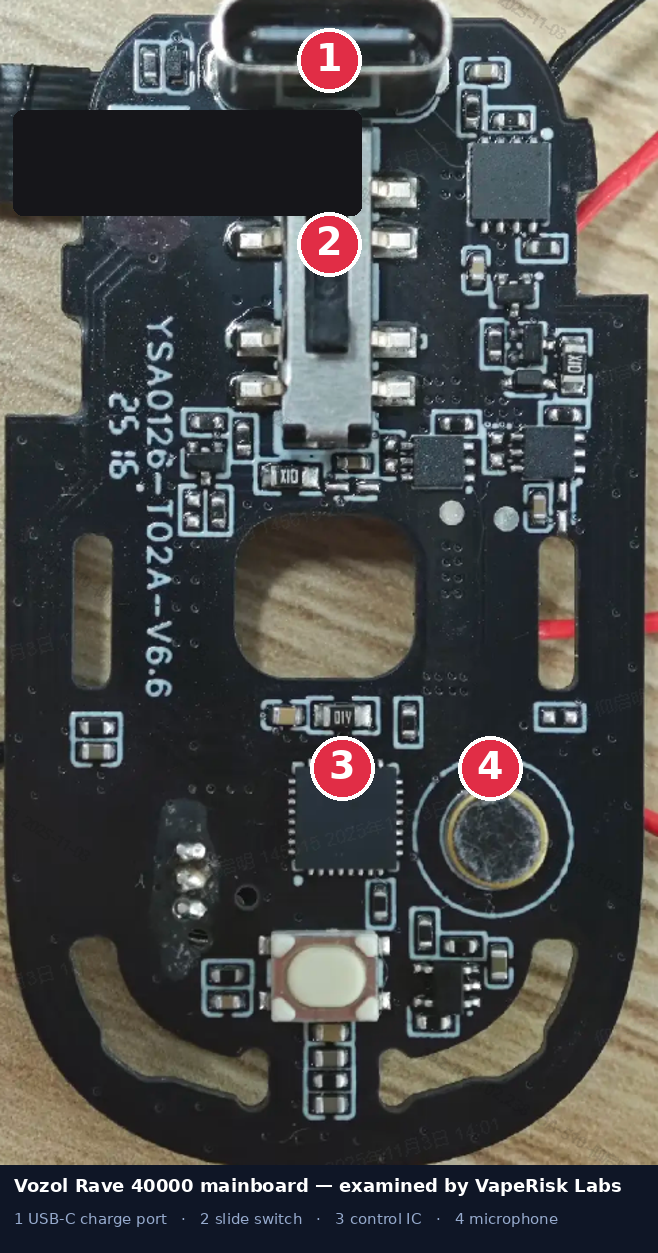
Component legend
Numbers correspond to the exploded teardown photo above.
The buyer questions this teardown answers
- Does the 40K-puff pitch have hardware behind it? The hardware is built for high-capacity use, but 40,000 remains a manufacturer claim. Our teardown can verify capacity, battery, coil resistance and output mode — not a real-world puff total.
- Why might liquid feel like it drops fast? Surge mode drives both coils at roughly 25 W, compared with roughly 15 W in Regular mode. Higher power can use liquid faster, so mode choice matters.
- Is the 270-degree screen just decoration? No. The light-show front is backed by a real flexible colour display and lighting system, not just a printed panel.
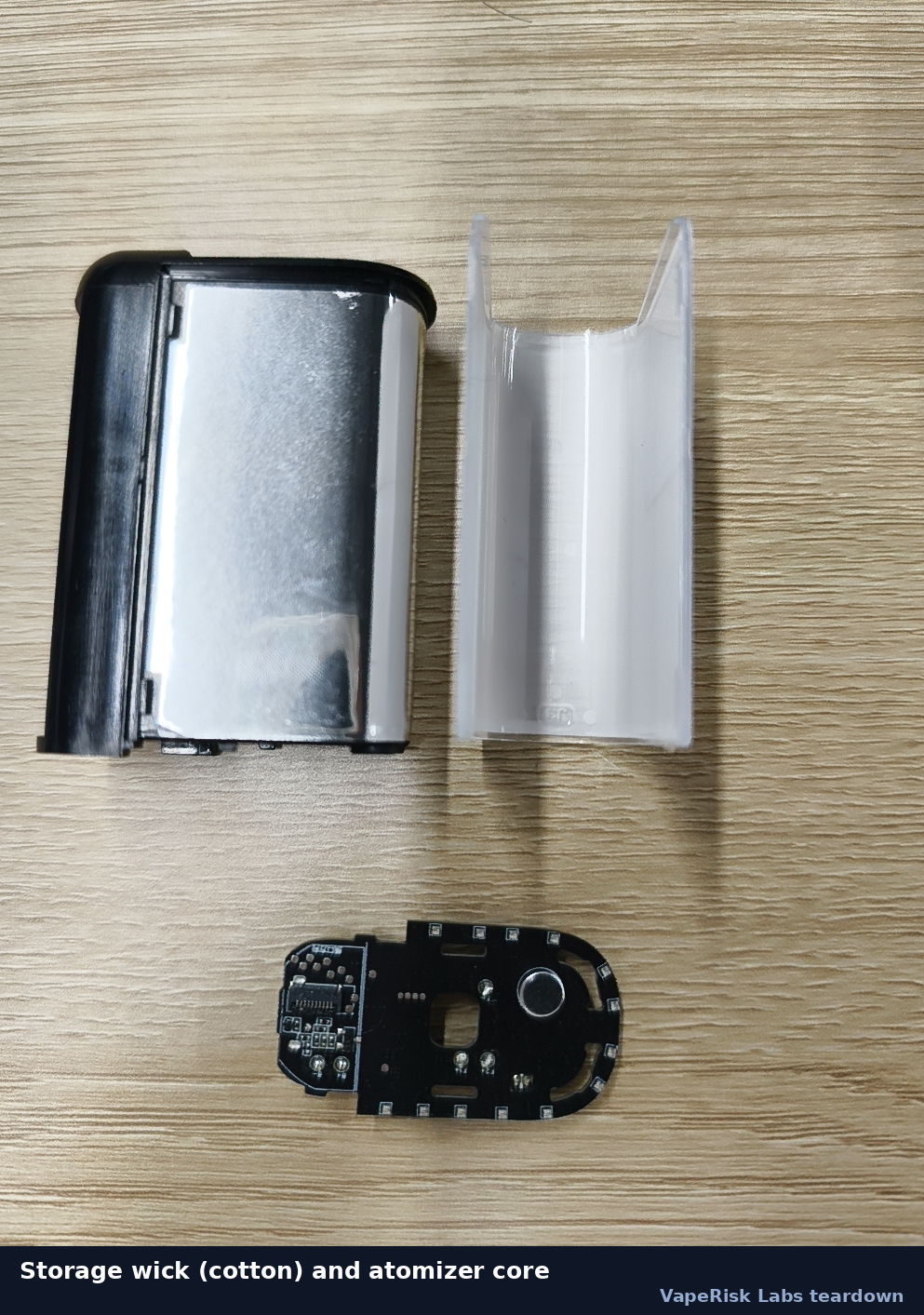
- Is the 20 ml label exact? On the unit we examined, the wick’s effective oil-holding worked out closer to about 18.5 ml, so the 20 ml number looks rounded.
- Did the teardown find a leak-risk area? The main structure concern was sealing around the atomizer path; our finding describes this unit, not every Vozol Rave 40000 on the market.
VapeRisk Labs scorecard
| Category | Score | Why |
|---|---|---|
| Output engineering | 8.5/10 | Genuine dual-coil, dual-mode output; power MOSFET sized for the higher-current mode; even-heating benefit at low power. |
| Display & interaction | 8.0/10 | Flexible FPC colour screen + 270° lighting give a richer UI than most disposables in the class. |
| Sealing / leak resistance | 6.0/10 | On the unit we examined, the overall seal was the weak point — see the structure section. |
| Spec-claim accuracy | 7.0/10 | Battery, coils and dimensions line up; the 20 ml capacity is marketing-rounded vs ~18.5 ml effective. |
| Overall build verdict | 7.6/10 | A feature-rich, genuinely dual-mode disposable whose main hardware trade-off is sealing, not output. |
Scores reflect the single unit we examined.
Key specs — as claimed vs as found on the bench
| Spec | Claimed / marked | VapeRisk Labs teardown (this unit) |
|---|---|---|
| Capacity | 20 ml | ~18.5 ml effective oil-holding (estimated) |
| Puffs | 40,000 (manufacturer claim) | Not tested — no standardised puff test run |
| Battery | rechargeable | 1000 mAh, 14500-size cell, 3.7 V / 3.7 Wh, USB-C |
| Coils | — | two mesh coils, measured ≈0.61–0.64 Ω each (parallel in dual mode) |
| Output modes | dual mode | Regular ≈ constant 15 W (single coil); Surge ≈ constant 25 W (both coils) |
| Draw resistance | — | ≈150 Pa, two airflow/sensitivity settings (≈20 and ≈26 mL/s) |
| Dimensions | — | 53.9 × 30.5 × 94.5 mm |
| Charging | fast charge | ≈900 mA constant-current, linear charging; input over-voltage cut-off observed (~7 V) |
| Standby draw | — | ≈5–9 µA measured |
What’s inside
Output — two coils, two modes, done properly
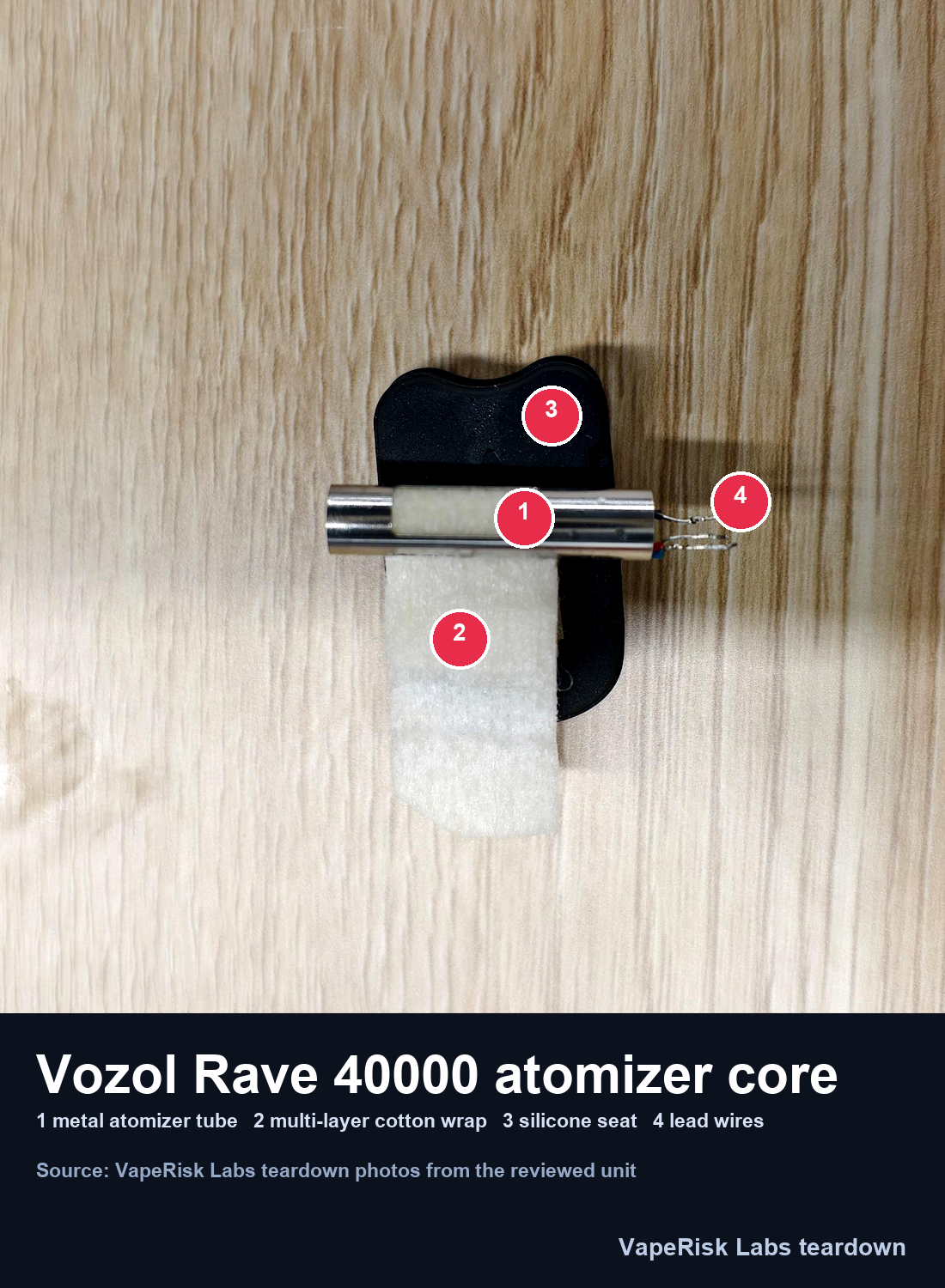
The Rave’s signature is its output. Inside are two mesh coils, and the device runs them in two ways: a Regular mode that drives a single coil at roughly constant 15 W, and a Surge mode that fires both coils at roughly constant 25 W. We confirmed the behaviour by loading the board on the bench and reading the output across the battery’s charge range. Splitting the work across two coils at lower power also spreads the heat, which helps keep the wick from running dry — a sensible piece of engineering rather than a marketing gimmick. The power-switching MOSFET is sized to handle the higher-current dual-coil mode.
Display and interaction — a real screen, not just LEDs
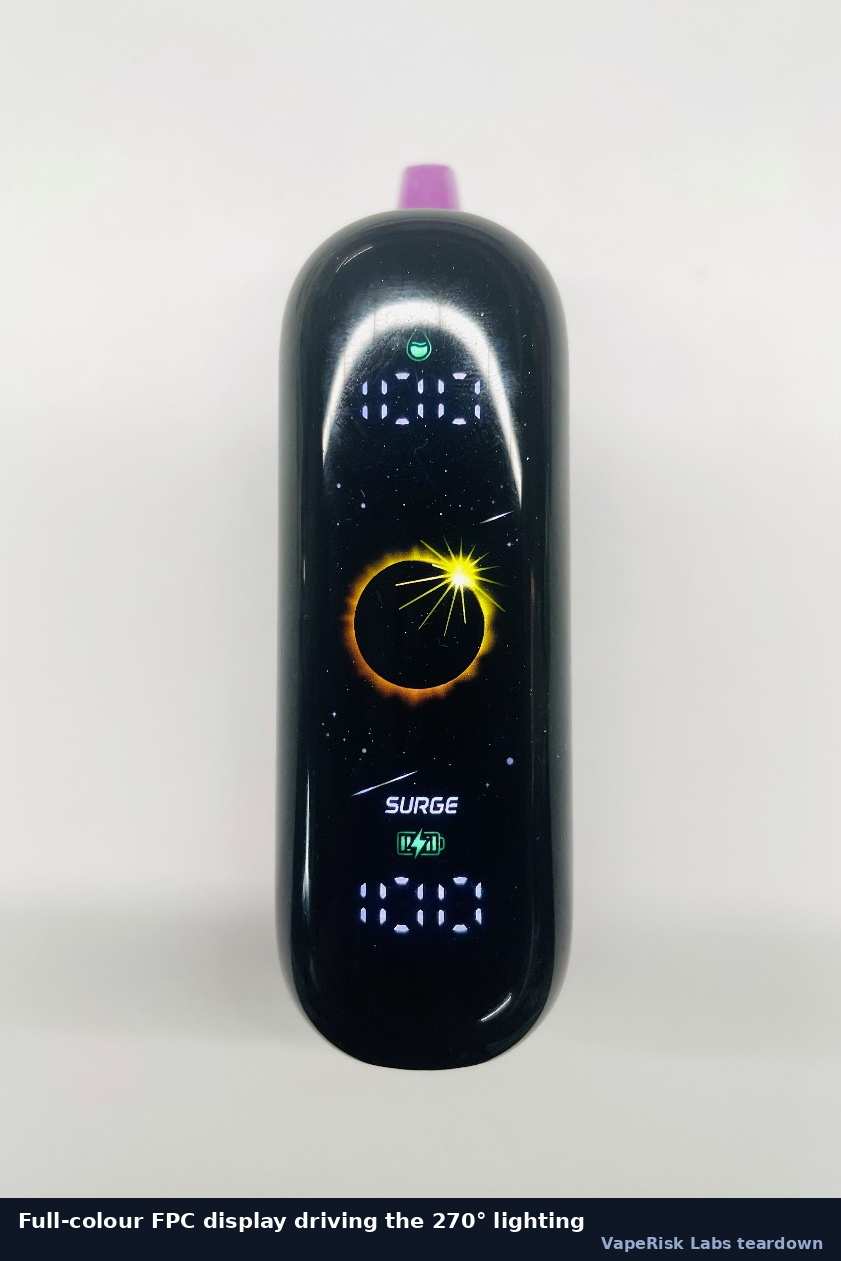
Interaction runs through a flexible (FPC) colour display rather than the simple LED bars common in this price class. It backs the 270° “star-field” lighting and the device’s animated party / radiation / stealth modes, and shows battery and e-liquid level. Visually it’s one of the more elaborate UIs in the high-capacity disposable category. One cosmetic note from the teardown: the screen panel uses an un-sprayed metallic-particle finish that looks premium but, on our unit, scratched easily and held fingerprints.
Structure and sealing — the weak point on this unit
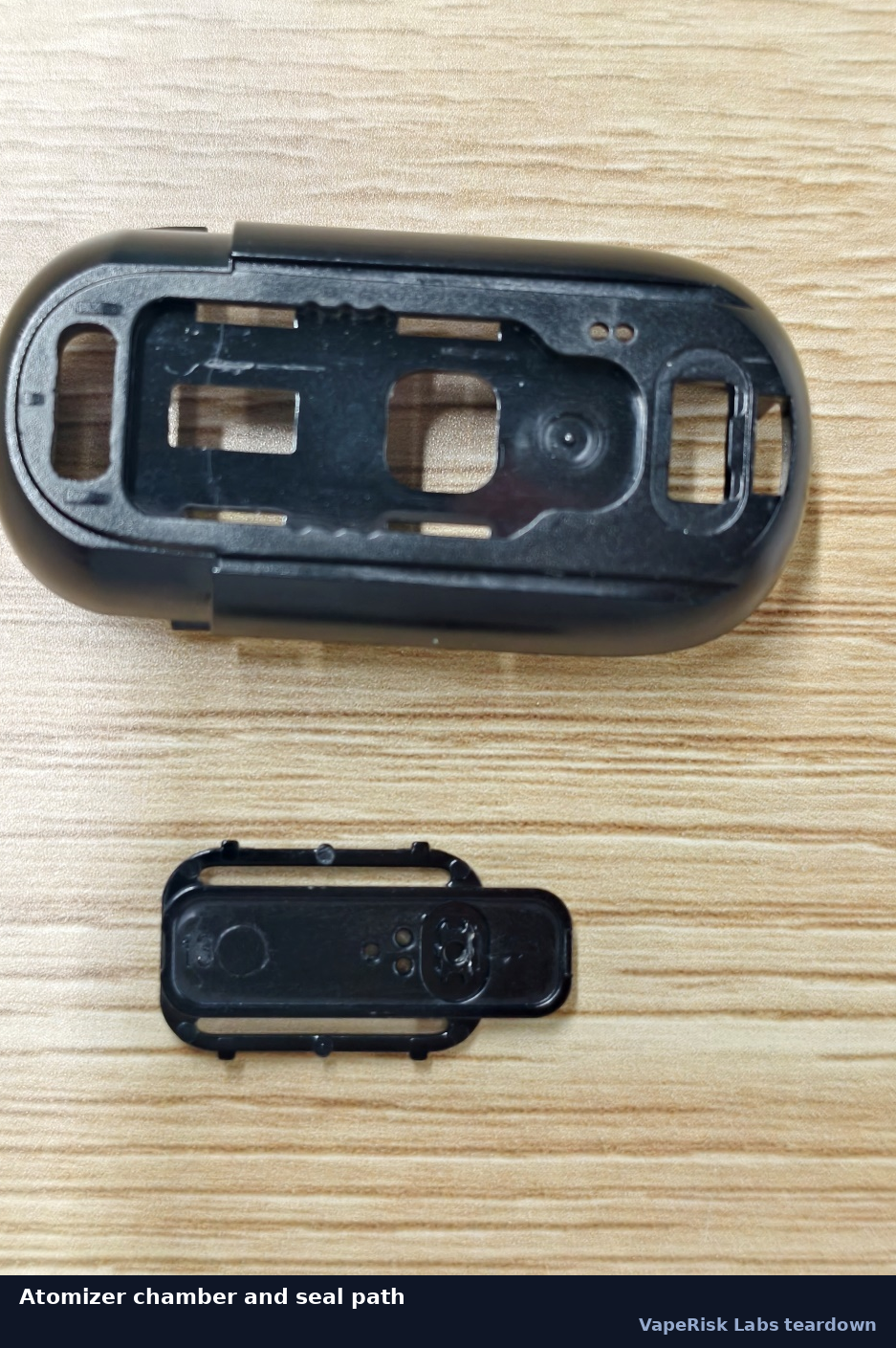
This is where our teardown is most useful to a buyer. On the unit we opened, the overall seal was the main weakness: the atomiser relies on a two-silicone-seal arrangement with solder joints on both the inside and outside of the seal path, and our structure notes flagged a tendency toward weaker sealing and some draw-back of condensate. It’s the kind of detail a flavour-only review never surfaces, and it’s specific to the sample we disassembled rather than a claim about every unit.
Charging and standby
Charging is linear, drawing about 900 mA in its constant-current phase over USB-C, and we observed an input over-voltage cut-off at roughly 7 V on the charge path. Standby current measured in the single-digit microamp range (≈5–9 µA depending on mode state), so idle battery drain is low.
Safety-related components we checked on this unit
We record which protection-related features were present on the specific unit we examined. This describes the unit we disassembled, and is not a safety rating of the brand or of other units.
- Electrostatic (ESD) protection: present — a TVS device on this unit’s board.
- Charge-path input over-voltage protection: present — we observed an input over-voltage cut-off (~7 V) on the charge path.
What the teardown says about the “40,000 puffs / 20 ml” claim
We want to be precise here, because it’s where marketing and hardware most often diverge — and where we will not overstate what we did.
- The 40,000-puff figure is Vozol’s claim. We did not run a standardised puffing test, so we make no measured puff-count statement. Real-world puff totals depend on draw length, power mode, and how dry the user runs the coils.
- What we can speak to is capacity. The tank is labelled 20 ml; the wick’s effective oil-holding works out to about 18.5 ml (estimated) on this unit. That gap is the practically useful, hardware-grounded fact: a buyer is carrying closer to ~18.5 ml of usable e-liquid than the 20 ml on the box.
- Battery side: the 1000 mAh rechargeable cell is consistent with a device meant to outlast a single tank via USB-C recharging, which is what its rechargeable positioning implies.
In short: the hardware is consistent with a high-capacity device, but the only number we’ll put our name to is the measured/estimated capacity, not a puff count.
How we examined this unit
This examination was carried out by VapeRisk Labs. We disassembled a Vozol Rave 40000 to the component level, photographed each part, and recorded materials, dimensions, and electrical behaviour on the bench. The findings above describe the specific unit we examined. Where a value is a manufacturer specification rather than our own observation, we label it as such.
Sources & evidence
- Primary evidence: VapeRisk Labs physical teardown and bench checks of one retail Vozol Rave 40000, including component photography and sample-specific observations.
- Manufacturer identity source: VOZOL Rave 40000 official product route, checked July 14, 2026. This link confirms the model identity; its dynamic page did not provide a stable specification table for this source review.
- Method and interpretation: VapeRisk Testing Methodology and the maintained Claimed vs Measured evidence hub.
FAQ
Does the Vozol Rave 40000 really do 40,000 puffs? 40,000 is Vozol’s manufacturer claim. We did not run a standardised puffing test, so we make no measured puff-count statement. What the teardown can check is the hardware behind the claim: capacity, battery, coil resistance and output power.
Why might the Vozol Rave liquid level seem to drop fast? One hardware reason is power mode. On the unit we examined, Regular mode ran one coil at about 15 W, while Surge mode ran both coils at about 25 W. Higher power can consume liquid faster, so the mode a user chooses matters.
Is the Vozol Rave’s 20 ml capacity accurate? The device is labelled 20 ml; on our unit the wick’s effective oil-holding worked out to about 18.5 ml (estimated). That suggests the 20 ml figure is marketing-rounded rather than a clean measured capacity.
What’s actually inside a Vozol Rave 40000? On the unit we examined: two mesh coils with a single-coil “Regular” (~15 W) and dual-coil “Surge” (~25 W) output mode, a 1000 mAh rechargeable 14500-size cell, a flexible FPC colour display driving the 270° lighting, and USB-C linear charging. Full measured specs are in the table above.
How big is the Vozol Rave 40000’s battery? We measured a 1000 mAh, 3.7 V / 3.7 Wh rechargeable cell (14500 size) on this unit, charged over USB-C at about 900 mA.
What safety-related components did the Vozol Rave teardown check? On the unit we examined we observed ESD protection (a TVS device) and an input over-voltage cut-off (~7 V) on the charge path. This describes the unit we disassembled and is not a safety rating of the brand.
Did the teardown find a leak risk? The structure notes flagged sealing as the main weakness on the unit we opened, especially around the atomizer path. This is a sample-specific teardown observation, not a claim that every Vozol Rave 40000 will leak.
Is the Vozol Rave refillable? No — it’s a single-use (disposable) device with a rechargeable battery, not a refillable pod kit. For refillable formats, see our 0+10 prefilled pod-kit guide.
Related VapeRisk coverage
- VapeRisk Labs — all teardowns
- See this finding in VapeRisk’s claimed-vs-measured table
- What is a 0+10 vape? The refillable format replacing disposables
- Compliance & market: bans, rules and what’s legal now
VapeRisk may consider evidence-led partnership proposals for testing, research, components, or compliance work, but no partner can buy coverage, a score, a ranking, a test result, or control of the method or conclusion. Partnership formats and enquiries are separate from editorial decisions; see the Sponsorship Standards.