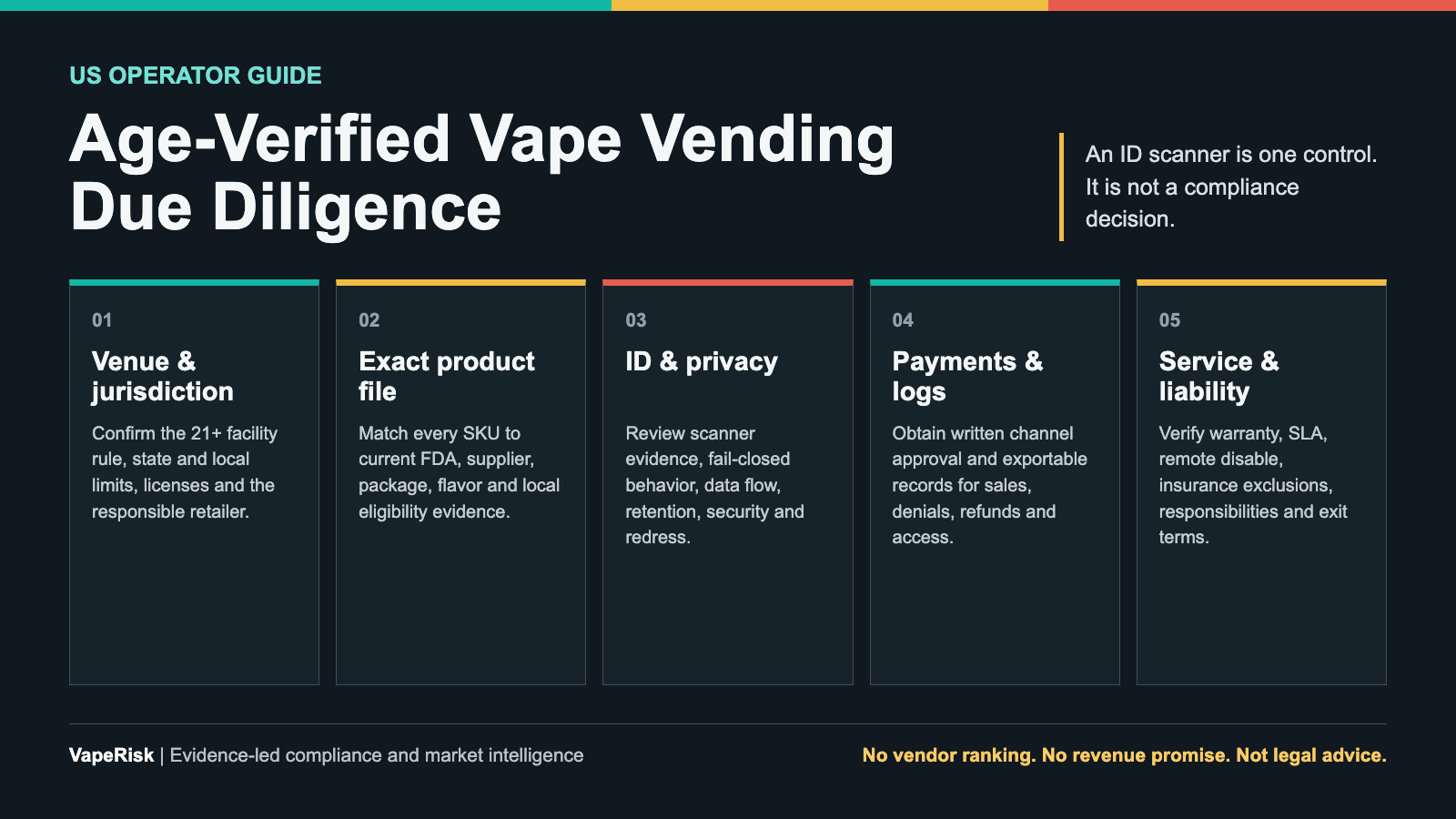
Quick answer: An ID scanner is only one control in a US vape-vending operation. Before buying or hosting a machine, the operator needs a written jurisdiction file, proof that the venue remains 21+ at all times, an exact-product FDA and local eligibility check, a documented ID-data flow, approved payment processing, service evidence and insurance that actually covers the operating model. A machine feature list cannot establish those points.
This is an operator due-diligence framework, not legal advice, a vendor ranking or a list of machine locations. Rules and product status change. Recheck the responsible federal, state and local sources for the proposed jurisdiction before signing a contract, stocking a product or activating a unit. For the broader retailer evidence workflow, use VapeRisk’s Vape Compliance & Market hub and Vape Retailer Intake File.
Start with the jurisdiction, not the machine
The federal rule is a floor. Under 21 CFR 1140.14, covered tobacco products cannot be sold to anyone under 21, purchasers under 30 must be verified by photographic identification, and vending is limited to facilities where the retailer ensures that no person under 21 is present or permitted to enter at any time.
That last condition matters: adding a scanner does not convert a mixed-age venue into a federally eligible vending site. State and local rules may then narrow the eligible setting, require direct employee control, license each machine as a retail location, restrict products or make a license unavailable.
| Example layer | What an operator should verify before purchase |
|---|---|
| Federal Tobacco 21 | Whether the facility is genuinely 21+ at all times, how photo-ID verification is performed, and which exact products may be marketed. |
| Massachusetts | Whether the proposed operation fits the state’s limited vending exception and its employee-controlled lockout and observation conditions. |
| California | Which entity holds the retailer license, whether each machine needs its own license, and what additional local permit or product rule applies. |
| New York State | Whether the setting is one of the settings allowed by state law and whether supervision/control conditions apply. |
| New York City | Whether an electronic-cigarette retail dealer license is available for the place of business and whether the proposed inventory is locally permitted. |
Ask the responsible state and local agencies a concrete question that names the operator entity, venue type, proposed operating model and machine. Keep the written response, application, permit, license and renewal date in the machine file. A sales representative’s general statement is not a jurisdiction determination.
Design the 21+ control as a system
A defensible control has several layers: adult-only entry, age verification before every restricted vend, a locked default state, secure time and event logs, remote disable, clear accountability and a documented response when verification or connectivity fails. Checking every buyer can be a conservative operating policy for an unattended system; it should not be misdescribed as the exact text of the federal under-30 ID rule.
Request the exact scanner make, model, firmware and software version. Ask which identity documents it accepts, whether it checks document authenticity rather than reading only a date-of-birth field, whether it verifies that the presenter is the document holder, and how it performs in the lighting and network conditions of the proposed installation. The machine should not dispense when the required age control is unavailable. The buyer also needs an accessible redress and refund process for legitimate customers whose verification fails, without exposing the vendor’s anti-fraud logic.
NIST’s current identity-proofing guidance is a useful technical benchmark for evidence validation, privacy risk, data minimization, protected channels and redress. It is not a tobacco-retail safe harbor and does not certify a commercial machine.
Check every product, not just the brand
FDA marketing authorization is product-specific. The FDA states that authorized e-cigarettes are not “FDA approved” and that authorization is not a finding that a product is safe. Start with VapeRisk’s current FDA-authorized e-cigarette list, then confirm the official FDA database and order materials on the date the item is approved for stocking.
For each machine slot, retain:
- front, back and side package photographs;
- manufacturer and full product name, including variant, flavor and nicotine strength;
- SKU, UPC or other stable internal identifier;
- FDA database entry, submission tracking number and order material where applicable;
- supplier identity, invoice and license evidence;
- state and local directory, flavor, tax and retail-eligibility checks;
- the person who checked the item, source URLs and check date; and
- a recheck date plus a quarantine/remote-disable process for changed status.
A brand-level match, a pending application, a supplier spreadsheet or the fact that an item is widely available is not a substitute for exact-product review. VapeRisk’s FDA list retailer checklist and guide to what PMTA means provide supporting terminology.
Map ID and privacy data before installation
Ask the vendor to diagram what the machine captures, where each field goes, which company receives it, how long it is kept and how it is deleted. Separate an age-result token from raw document images, document numbers, face images, geolocation, device identifiers and payment data. The buyer should know whether processing occurs on the machine, in a vendor cloud or through another identity provider, and should receive a list of subprocessors and storage regions.
Prefer the minimum record needed to prove the control operated: machine ID, time, software version, pass/deny/error result and a reason code that does not expose personal identity data. Require encryption, role-based access, audit trails, breach notification, retention limits, deletion procedures and a usable consumer contact route.
Privacy duties vary. California identifies government identifiers, precise geolocation and identifying biometrics as sensitive personal information under the CCPA framework when the law applies. Illinois separately regulates covered biometric identifiers and information, including face geometry, with notice, retention and release requirements. If a system uses a face comparison, liveness process or other biometric, obtain the actual technical data flow and jurisdiction-specific review before deployment.
Verify payments and telemetry as separate systems
A card reader does not prove that the operator has been approved for tobacco or e-cigarette transactions. Identify the merchant of record and obtain written approval from the processor or acquirer for the exact products, unattended-vending channel and operating entity. Record pricing, tax handling, refunds, chargebacks, settlement timing, reserve terms and what happens during a network outage.
The PCI Security Standards Council explains that outsourcing payment processing does not eliminate the merchant’s oversight responsibilities. Ask for the provider’s current compliance evidence, the written division of responsibilities and the operator’s required validation path. Keep age-verification data outside the card-data environment wherever the reviewed design permits; do not assume encryption alone removes a system from scope.
Useful telemetry should answer operational questions without becoming a customer-surveillance system. At minimum, evaluate machine uptime, connectivity, inventory by exact SKU, successful vends, failed vends, age-control pass/deny/error events, refunds, price changes, door openings, remote disables, jams, stockouts and service tickets. Confirm that logs use reliable time, can be exported, cannot be silently rewritten and remain available after a contract ends.
Put serviceability into the contract
Request the warranty, exclusions and service-level agreement before paying a deposit or accepting an installation. The documents should identify who owns the unit, who stocks it, who holds keys and administrator access, who can change products or prices, who responds to a failed age control, and who can disable the machine immediately.
Verify parts availability, local or dispatched service coverage, response targets, escalation contacts, software-update policy, end-of-support terms and data export. Site acceptance should include mounting and anchoring, electrical listing and grounding, network segmentation, door and lock controls, accessible clear space and operable parts, test vends, refund handling and a photographed serial/configuration record. Service personnel need a documented de-energization and isolation process for applicable work.
Read the insurance, exclusions and liability split
General liability, product liability and commercial property are useful starting categories, not proof of coverage for this business. Ask a licensed commercial broker to review the actual operator, host, inventory, vending channel and jurisdictions. Depending on the facts, the review may also include cyber/privacy, equipment breakdown, crime, workers’ compensation, commercial auto, umbrella and recall-related exposures.
Check definitions and exclusions for tobacco, nicotine, e-cigarettes, batteries, age-restricted sales, product liability, off-premises machines, data incidents and contractual liability. Confirm limits, deductibles, territory, additional-insured status, notice of cancellation and whether the policy follows every machine location. A vendor’s promise to take responsibility and a contract indemnity clause do not replace policy evidence.
Demand operator evidence, not an income story
Before treating a machine as proven, ask for one named, referenceable installation with the same model, scanner stack and service plan. Review at least 90 consecutive days of redacted uptime, vend, denial, refund, jam, stockout, chargeback and service-ticket data. Confirm the record with the operator and host venue, and reconcile a sample of telemetry to processor settlements, inventory movement and completed service work.
Do not base the decision on projected venue income, selected dashboard screenshots, unverified installation counts or claims that the operation requires no work. A commercial model can be evaluated only after fees, inventory cost, tax, refunds, chargebacks, shrink, commissions, connectivity, software, insurance, licensing and service are measured for the same period.
Buyer checklist before signing
- Jurisdiction: written federal, state and local review for the named operator, venue and machine.
- 21+ venue: documented entry policy and evidence that no person under 21 is present or permitted to enter at any time.
- Licensing: retailer, machine, tax and local permits assigned to the correct entity, with renewal dates.
- Products: exact-SKU FDA, supplier, state and local evidence for every slot.
- ID control: exact hardware/software, test method, fail-closed behavior, logs and redress.
- Privacy: data map, purpose, notice, retention, deletion, security, subprocessors and biometric review.
- Payments: merchant of record, written processor/acquirer approval, PCI responsibility and refund/chargeback terms.
- Telemetry: exportable, time-reliable logs for age control, sales, inventory, access, disable and service events.
- Service: signed SLA, warranty, exclusions, parts, escalation, remote disable and end-of-support terms.
- Installation: accessibility, anchoring, electrical/network review and documented site acceptance.
- Insurance: policy and endorsement review for nicotine, product, machine, location and data risks.
- Contract: clear ownership of retail sales, stock, data, keys, admin access, taxes, recalls, complaints and indemnity.
- Operator proof: a real reference plus redacted 90-day evidence from the same configuration.
- Exit: data export/deletion, machine removal, inventory disposition, chargebacks and permit closure.
What public evidence can and cannot establish
Official sources can support the legal floor and the questions a prudent operator should ask. Public vendor pages can show which features are advertised. Neither source type proves how a specific machine, contract or installation performs. Until a real operator interview and machine-level records are available, this guide should remain an unranked due-diligence framework with no vendor verdict, compliance badge, performance claim or financial projection.
Verify product identity before loading the machine
Age control does not establish that a product is authentic, accurately labelled or eligible for the intended market. Keep the exact pack, SKU and supplier record, then use the official-domain authenticity workflow and the product-label evidence checklist as separate intake steps.
Frequently asked questions
Are vape vending machines legal in the United States?
There is no single nationwide yes-or-no answer for a proposed installation. Federal rules restrict covered-tobacco-product vending to facilities where no person under 21 is present or permitted to enter at any time, while state and local rules can add setting, supervision, licensing and product restrictions. Check the named operator, venue, machine and inventory before contracting or operating.
Does an ID scanner make a vape vending machine compliant?
No. A scanner is one control, not a compliance determination. The operator still needs an eligible 21+ facility, correct licenses, exact-product eligibility, a reliable and privacy-reviewed age-control process, approved payments, servicing, records and any additional state or local controls.
Must a vape vending machine be in a 21+ facility?
For covered tobacco products, the federal vending exception applies only where the retailer ensures that no person under 21 is present or permitted to enter at any time. State or local law may impose narrower setting or supervision conditions. A machine-level age check does not replace the federal facility condition.
How should an operator check whether a vape product can be stocked?
Match the exact package and product variant to current FDA sources, retain the submission or order evidence, verify the supplier and invoice, and then check state and local product, flavor, directory, tax and licensing rules. Record the source URLs, reviewer and date, and repeat the check on a schedule.
What ID data should an operator retain?
Retain only what the reviewed legal and operational purpose requires. A minimal audit record may use machine ID, time, software version and pass, deny or error status without storing a raw ID image or document number. The actual design needs a documented data map, notice, security, retention, deletion, subprocessor and biometric review.
What payment and telemetry evidence should a buyer request?
Request written processor or acquirer approval for the exact business model, the merchant of record, current PCI responsibility evidence, refund and chargeback terms, and exportable machine logs for sales, age-control events, inventory, access, outages, remote disables and service. A card-reader logo or dashboard screenshot is not enough.
What proof should a machine vendor or operator provide?
Ask for the exact installed configuration, jurisdiction and license file, product records, data-flow and scanner test evidence, processor approval, warranty and SLA, insurance documents, and at least 90 consecutive days of redacted machine-level operating data confirmed with a real operator and host venue.
VapeRisk may consider evidence-led partnership proposals from age-verification, payments, telemetry, compliance, insurance, testing or retail-technology providers, but no partner can buy a vendor ranking, legal conclusion or favourable finding. Partnership formats and enquiries are separate from editorial decisions; see the Sponsorship Standards.
Editorial review: Source and compliance-language check completed 17 July 2026 under the VapeRisk Policy Editor role. This guide is for operational due diligence and does not replace advice from the responsible agencies, qualified counsel, a privacy professional, payment/acquiring partners, an accessibility professional or a licensed insurance broker.