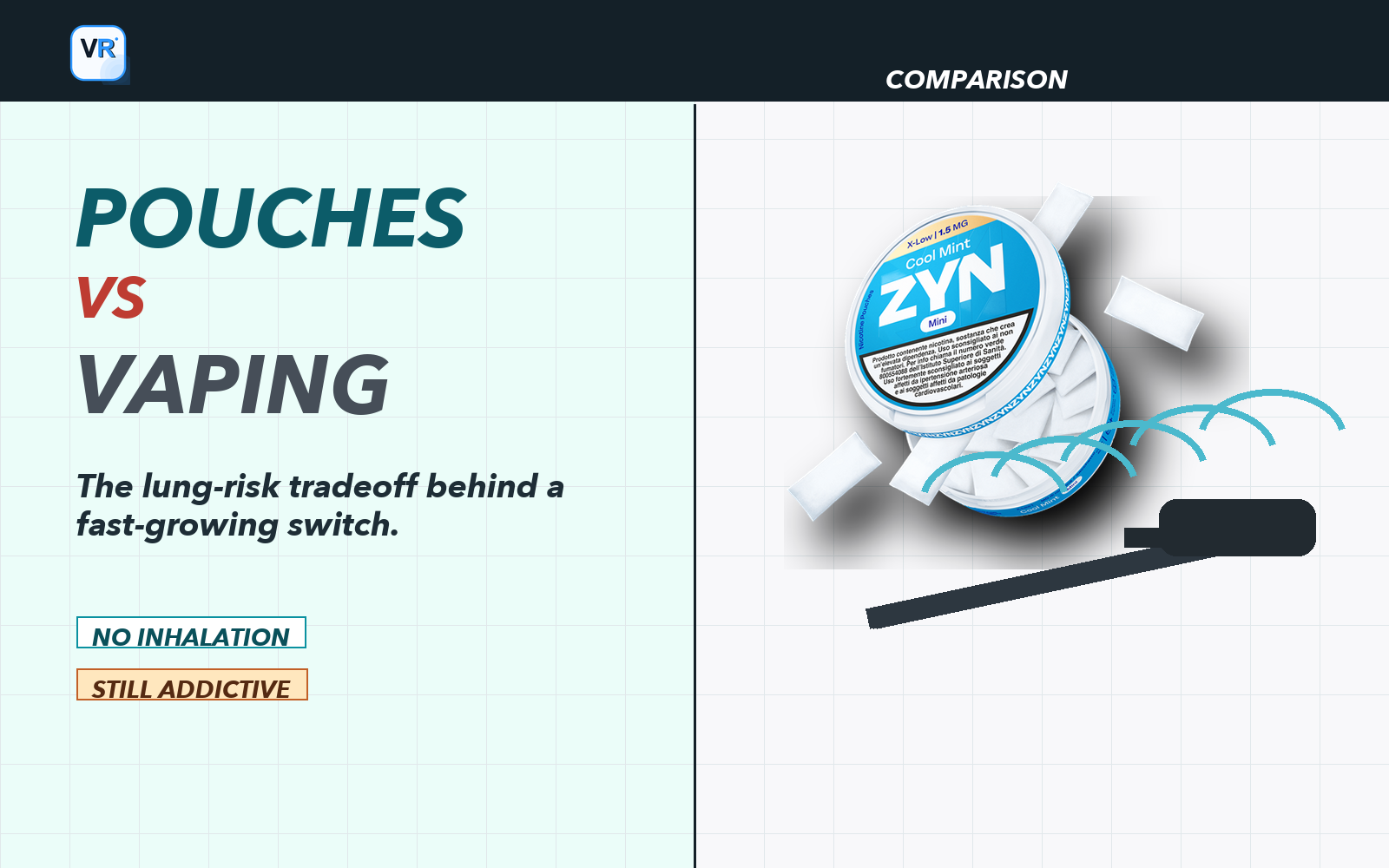
The pouch-versus-vape question sounds simple. The honest answer is a lung-risk tradeoff, not a clean bill of health.
Quick answer: On lung and inhalation exposure, nicotine pouches are likely lower-risk than vaping because you do not breathe anything in. There is no aerosol, no device heating and no second-hand vapour cloud. But “lower lung exposure” is not the same as “safe.” Both products deliver addictive nicotine, both can affect heart rate and blood pressure, and pouches have much thinner long-term evidence. For an adult smoker or vaper trying to reduce inhalation exposure, pouches may be a lower-lung-risk switch. For a non-smoker, the lowest-risk choice is neither.
The real difference is inhalation
Vaping heats liquid and sends aerosol into the lungs. A pouch sits under the lip and delivers nicotine through the mouth. That is the core reason pouches are often framed as lower-risk for the lungs: there is nothing to inhale and no visible vapour for bystanders.
That advantage should not be overstretched. There are not decades of direct outcome data comparing long-term pouch users with long-term vapers. The strongest claim is narrower and mechanistic: pouches avoid the lung-aerosol exposure that defines vaping.
Where the risks overlap
Nicotine itself does not disappear. It is addictive and can raise heart rate and blood pressure however it is delivered. Pouches can also irritate gums or oral tissue, and public-health summaries have raised product-contamination concerns in some tested pouches.
| Risk dimension | Nicotine pouch | Vaping |
|---|---|---|
| Inhalation / lung exposure | None from the product | Aerosol inhaled into the lungs |
| Second-hand aerosol | None | Possible second-hand vapour exposure |
| Nicotine dependence | Yes | Yes |
| Heart rate / blood pressure | Nicotine-related concern | Nicotine-related concern |
| Oral effects | Gum or mouth irritation | Dry mouth or throat irritation |
| Product contaminants | Reported in some products | Reported in some devices/liquids |
| Long-term evidence | Very limited | Limited, but broader than pouches |
So which is safer?
If the question is “which exposes my lungs to less?”, the answer is pouches. If the question is “which is safe?”, neither. A pouch can be a harm-reduction step for an adult already using nicotine who wants to avoid inhalation, especially if the product is legally authorised or otherwise regulated where they live. It is not a reason for a non-user to start.
If your goal is to quit nicotine, switching from vape to pouch can keep the dependence loop alive. That does not make it useless for every adult user, but it means the goal should be clear: reducing inhalation exposure is not the same as quitting.
Sources reviewed
- FDA list of authorised nicotine pouch products
- FDA ZYN authorisation announcement
- FDA 2024 National Youth Tobacco Survey summary
- American Cancer Society explainer on nicotine pouches and cancer risk
- American Lung Association summary of emerging nicotine products
FAQ
Are nicotine pouches safer than vaping?
For lung and inhalation exposure, nicotine pouches have a clear mechanical advantage because nothing is inhaled. That does not make them safe: both products deliver addictive nicotine, and long-term pouch evidence remains limited.
Is ZYN safer than vaping?
ZYN avoids inhalation because it is a pouch, but it still delivers addictive nicotine. The FDA authorisation for specific ZYN products is not a declaration that ZYN is safe or FDA-approved.
Do nicotine pouches affect your heart?
Nicotine can raise heart rate and blood pressure regardless of delivery route, so cardiovascular concerns still apply to pouch users.
Are nicotine pouches a good way to quit vaping?
They may reduce aerosol exposure, but they usually replace one nicotine habit with another. For quitting nicotine entirely, use professional cessation support.
General information, not medical advice. To stop smoking or using nicotine, speak to a healthcare professional or your local stop-smoking service.