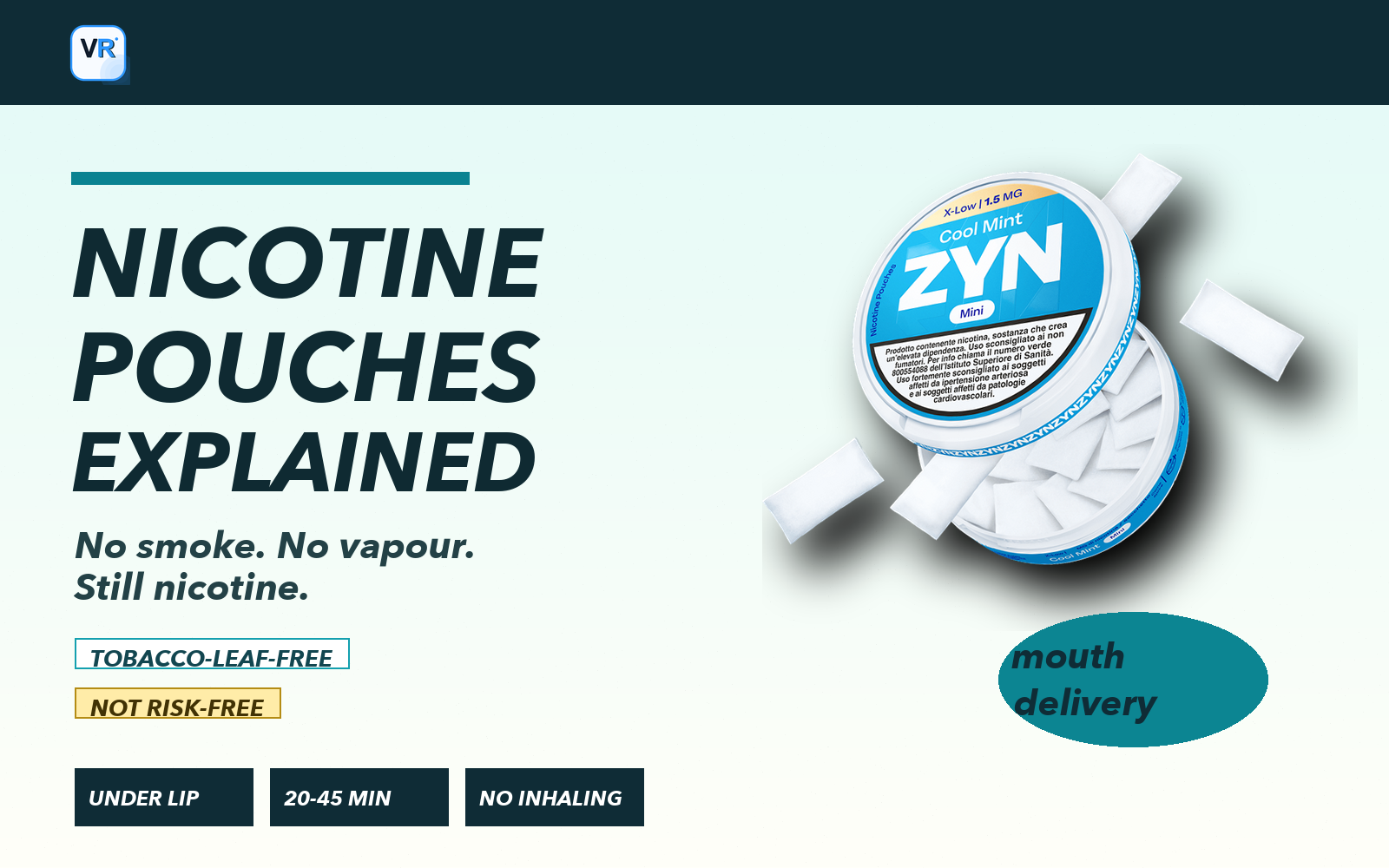
The fastest-growing nicotine product is a small white pouch you can hide under your lip. It has no smoke and no vapour — but it is still nicotine.
Quick answer: A nicotine pouch is a small, tobacco-leaf-free pouch you tuck between your gum and upper lip. It releases nicotine through the lining of your mouth, so there is no smoke, no vapour and nothing inhaled. That matters: compared with smoking, an authorised pouch can reduce exposure to several harmful chemicals for an adult smoker who switches completely. But pouches are not safe and they are not a medical quit product by default. Nicotine is addictive, can raise heart rate and blood pressure, can irritate the mouth, and public-health groups have flagged contaminants in some pouch products. They are not for non-smokers, pregnant people, or anyone under the legal age for nicotine products.
What is actually inside a nicotine pouch?
Most pouches use nicotine extracted from tobacco or made synthetically, packed into a small fibre pouch with fillers, pH adjusters, sweeteners, flavourings and stabilisers. You do not light it, inhale it or spit tobacco leaf. You park it under the upper lip for roughly 20 to 45 minutes while nicotine absorbs through the oral lining.
The selling point is also the risk signal: pouches are discreet, flavoured and easy to use in places where smoking or vaping would be obvious. That is why regulators focus so heavily on youth appeal and marketing controls.
Nicotine pouch vs snus vs vaping
- Vs Swedish snus: snus contains tobacco leaf; nicotine pouches are tobacco-leaf-free. The under-lip use looks similar, but the product category is not identical.
- Vs vaping: vaping sends aerosol into the lungs. A pouch delivers nicotine through the mouth. That removes the lung-aerosol question, but it does not remove nicotine dependence or cardiovascular concerns. We compare the two in are nicotine pouches safer than vaping?
- Vs cigarettes: no combustion means no tar or carbon monoxide from smoke. The FDA has authorised specific ZYN and on! PLUS products for US sale, but the agency also stresses that authorised does not mean safe or FDA-approved.
Are nicotine pouches safe?
No nicotine product should be treated as safe. The best-supported claim is narrower: for an adult who already smokes and switches completely, a pouch may reduce exposure compared with cigarettes. That is very different from saying a pouch is harmless for a non-smoker.
The remaining risks are real. Nicotine is addictive and can affect heart rate and blood pressure. Pouches can irritate gums and oral tissue. Long-term data is still limited because the category is newer than smoking and smokeless tobacco. The American Cancer Society notes that pouches may contain harmful chemicals such as formaldehyde or metals, and the American Lung Association summarises a 2022 study that found cancer-causing chemicals in some tested products.
Why youth use worries regulators
The FDA’s 2024 youth survey found that 1.8% of US middle and high school students — about 480,000 students — reported current nicotine pouch use. FDA also says current pouch use did not show a statistically significant change from 2023 to 2024, so the cleanest reading is not “everyone is switching to pouches.” The concern is more specific: flavour, discretion and viral brand culture make pouches unusually easy to hide, share and normalise.
Regulation snapshot
Rules are changing quickly. In the US, only listed FDA-authorised pouch products may be lawfully sold. France’s decree bans oral nicotine products from April 2026, with narrow exemptions for medicines, medical devices and research. At EU level, nicotine pouches still sit outside the current Tobacco Products Directive categories; the revision is expected to address them, but the final timing and content are not settled. See where nicotine pouches are banned for the current map.
Sources reviewed
- FDA list of authorised nicotine pouch products
- FDA ZYN authorisation announcement
- FDA 2024 National Youth Tobacco Survey summary
- American Cancer Society explainer on nicotine pouches and cancer risk
- American Lung Association summary of emerging nicotine products
FAQ
What are nicotine pouches?
Small tobacco-leaf-free pouches placed between the gum and upper lip that release nicotine through the mouth’s lining — no smoke, no vapour, nothing inhaled.
Are nicotine pouches safe?
No. They may reduce exposure compared with cigarettes for an adult smoker who switches completely, but they still deliver addictive nicotine and can carry oral, cardiovascular and product-contamination risks.
Are nicotine pouches the same as snus?
No. Swedish snus contains tobacco leaf. Modern nicotine pouches are tobacco-leaf-free and usually shelf-stable, although the under-lip delivery method looks similar.
How long do you keep a nicotine pouch in?
Most products are used for roughly 20 to 45 minutes under the upper lip. Do not chew or swallow the pouch.
Are nicotine pouches addictive?
Yes. They deliver nicotine, which is addictive regardless of whether it is smoked, vaped or absorbed through the mouth.
This article is general information, not medical advice. If you want to stop smoking or using nicotine, speak to a healthcare professional or your local stop-smoking service.