JNR sells the 100K on a huge headline number — up to 64 mL of e-liquid and a 100K-puff name. We took one apart to see what that number really means once you’re holding the hardware.
Quick answer: The JNR 100K is a 2+10 refillable kit — a refillable cartridge (a 2 mL pod feeding off a ~10 mL reservoir) on a magnetic 1200 mAh rechargeable battery rod, fronted by a large curved colour screen. It’s genuinely refillable and the build separates the airflow sensor from the oil path (a real anti-leak touch). But the headline maths needs context: you carry ~12 mL per fill, and the advertised “up to 64 mL / 100K” total is reached across several cartridge refills — and our teardown notes the coil isn’t likely to outlast that full advertised volume, so you’ll be buying replacement cartridges along the way. The 100K-puff figure itself is a manufacturer claim; we didn’t run a puff test.
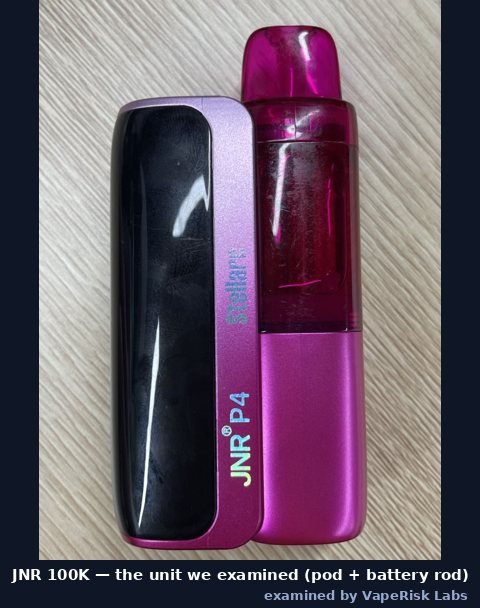
The buyer questions, answered
Does the 64 mL / 100K-puff claim hold up? It’s a manufacturer claim, and the way to read it is “total over the life of the kit, across refills” — not one tankful. The hardware holds ~12 mL per fill (2 + ~10 mL) on a 1200 mAh rechargeable cell. Our teardown’s own note is the honest caveat: the coil may not survive the full advertised volume, so reaching the big number means replacing cartridges.
Is it actually refillable? Yes — there’s a side fill port and the battery rod recharges over USB-C. Two things to know: the cartridge is locked to its reservoir on four sides (it’s a fixed 2+10, not a free pod-swap system), and the cartridge can’t vape on its own — it only works docked to the battery rod via pogo pins.
How’s the battery and power? A 1200 mAh cell driving a measured ~16 W (close to the 17 W claim), with charging at about 0.8 A and roughly two hours to full. Standby draw measured under 15 µA.
Will it leak? It’s an open 2+10 system, so treat leaks as possible. The good news from the teardown: the airflow sensor sits on a separate path from the oil, so condensate is less likely to reach it. The watch-out: we found condensate building in the wick by the time the reservoir was around two-thirds down.
Is it worth £24.99? If you want a big-capacity refillable kit with a striking curved screen and don’t mind buying replacement cartridges to chase the headline volume, it’s a reasonable buy. If you expected 64 mL from one coil, that’s not how this works.
VapeRisk Labs scorecard
| Category | Score | Why |
|---|---|---|
| Refill / capacity design | 7.0/10 | Real 2+10 refill, but fixed (four-side locked) and the headline volume implies cartridge replacements. |
| Anti-leak engineering | 7.0/10 | Sensor separated from the oil path; but condensate builds in the wick as the reservoir empties. |
| Battery / power | 7.5/10 | 1200 mAh, measured ~16 W, holds output well down the charge; ~2 h to charge. |
| Screen / interaction | 8.0/10 | Large curved FPC colour screen with a genuinely rich star/meteor UI. |
| Spec-claim accuracy | 6.5/10 | Measured power lands near the claim; the “64 mL / 100K” total needs the refill-life caveat. |
| Overall build verdict | 7.2/10 | A capable big-capacity refillable let down only by how the marketing volume reads vs coil life. |
Scores reflect the single unit we examined.
Key specs — claimed vs found on the bench
| Spec | Claimed / marked | VapeRisk Labs teardown (this unit) |
|---|---|---|
| Format | 2+10 refillable kit | Refillable cartridge + magnetic battery rod (confirmed) |
| Price / market | £24.99, UK | — |
| Puffs / capacity | up to 64 mL / “100K” | Not puff-tested; ~12 mL per fill (measured); 64 mL is a multi-refill total |
| Battery | — | 1200 mAh, 3.7 V / 4.44 Wh, “164500” cell (marked) |
| Power | 17 W | measured ≈16 W (constant-RMS, ~1.2 Ω section) |
| Atomizer | — | parallel mesh heating sections, ≈0.6 Ω (measured; ~1.2 Ω per section) |
| Airflow | 2 settings | 2-step: ≈135–179 Pa (open) / ≈264–289 Pa (closed) (measured) |
| Vapour (TPM) | — | ≈13.5–18.5 mg depending on draw (measured) |
| Charging | — | ≈0.8 A constant current, ~2 h to full; input over-voltage cut-off ≈7 V (measured) |
| Standby draw | — | under 15 µA (measured) |
| Dimensions | — | 101 × 50 × 25 mm (measured) |
What’s inside
The cartridge — a fixed 2+10
The cartridge holds the atomizer, a steel storage tube and wick, the reservoir and the magnets. It’s a genuine refill, but the cartridge and its reservoir are locked together on four sides — a deliberately fixed 2+10 rather than a swap-any-pod system — and it only fires when docked to the battery rod.
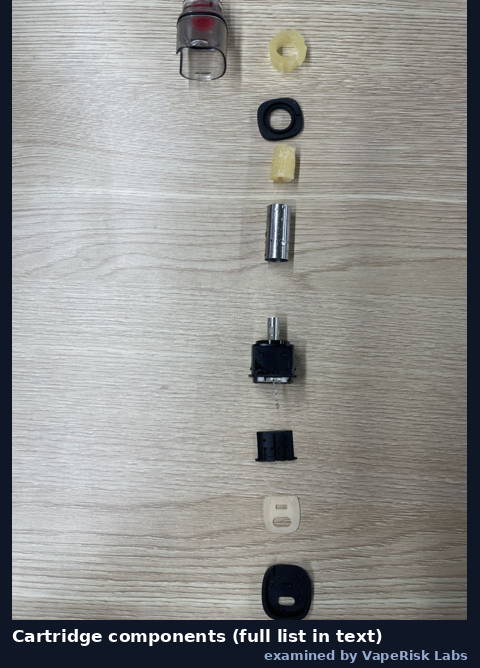
Cartridge parts (full list): the atomizer (parallel mesh), steel storage tube, storage cotton/wick, two metal liquid-guide posts, reservoir (PCTG), airflow toggle, electrode and magnets.
The atomizer
The atomiser uses parallel mesh heating sections (we measured ≈0.6 Ω; ~1.2 Ω per section) wrapped in cotton. Airflow runs through a 2-step toggle (an “open” and a “closed” setting), which our bench draw figures put at roughly 135–179 Pa and 264–289 Pa.
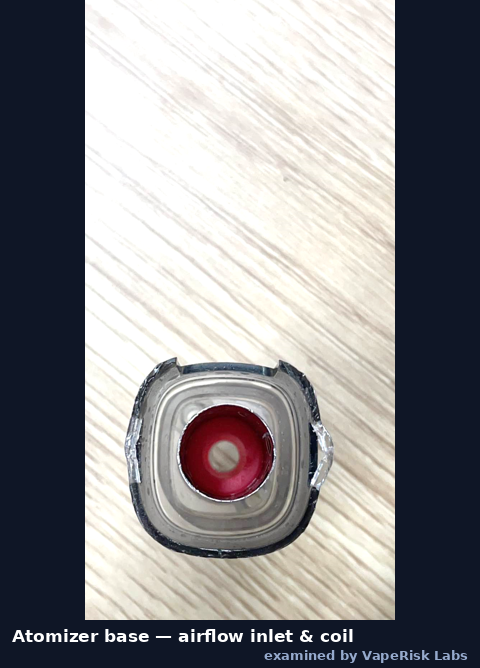
The battery rod
The rod carries a 1200 mAh “164500” cell and the mainboard, mating to the cartridge by magnets and pogo pins. We measured charging at about 0.8 A with roughly two hours to full.
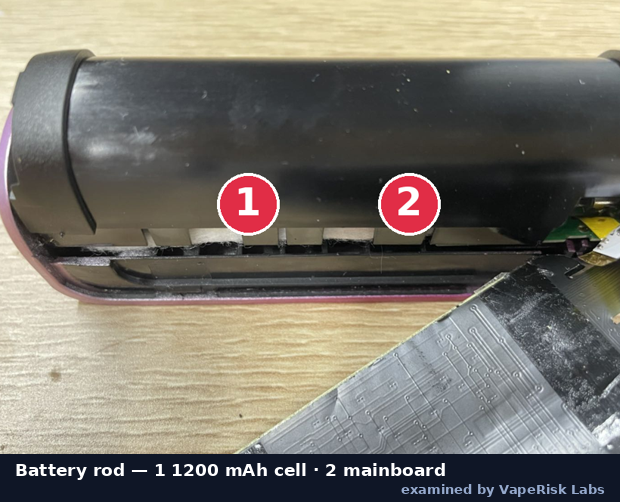
The mainboard
The board carries the MCU, charge IC, output MOSFET, the microphone (airflow) sensor, a curved-screen driver and a USB-C input. Standby draw measured under 15 µA, and the cell holds the ~16 W output well even as it drains.
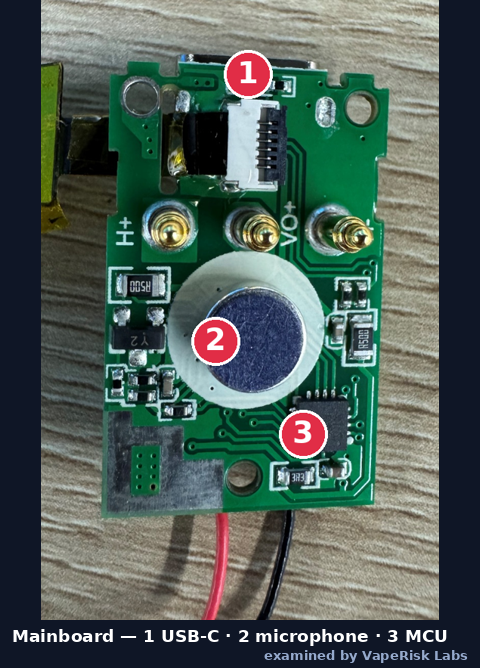
Mainboard: 1 USB-C input · 2 microphone (airflow sensor) · 3 MCU. The board also carries the charge IC and the curved-screen driver.
Safety-related observations (this unit)
These describe the unit we examined and are not a safety rating of the brand or of other units.
- Charge management: present — a dedicated charge-management IC with a USB-C input; we measured charging at ≈0.8 A constant current with an input over-voltage cut-off at ≈7 V, ~2 h to full.
- Cell: a single “164500” 1200 mAh / 3.7 V / 4.44 Wh cell in the magnetic battery rod.
- Airflow/oil separation: the airflow sensor sits on a separate path from the oil — observed on this unit as an anti-leak design choice.
Where the teardown evidence on a component was mixed, we’ve left it out of this write-up and flagged it for a closer photo-level check rather than state it here.
Marketing claim analysis — what holds up
| JNR says | What the teardown shows | Verdict |
|---|---|---|
| “up to 64 mL” total | ~12 mL per fill; the total is reached across refills | Manufacturer claim — needs the refill-life caveat |
| “100K” | high-capacity refillable hardware | Manufacturer claim — not puff-tested by us |
| Refillable 2+10 | Genuine side-fill reservoir; recharges over USB-C | Confirmed — but fixed (four-side locked) |
| Big curved screen | Large curved FPC colour display | Confirmed |
| (unstated) | Coil may not outlast the advertised volume → cartridge replacements; cartridge can’t fire alone | The buyer-relevant facts the box leaves out |
How we examined this unit
This examination was carried out by VapeRisk Labs. We disassembled a JNR 100K to the component level, photographed each part, and recorded materials, dimensions, and electrical behaviour on the bench. The findings above describe the specific unit we examined. Manufacturer figures are labelled claimed; bench figures are labelled measured or estimated. VapeRisk Testing Methodology defines these evidence labels and limits. For cross-device context, compare this result in Claimed vs Measured and use Battery Capacity vs Puff Count when interpreting battery or puff figures.
FAQ
Does the JNR 100K really hold 64 mL or do 100K puffs?
Those are manufacturer claims describing totals across refills, not one tankful. The hardware holds about 12 mL per fill on a 1200 mAh rechargeable cell. We didn’t run a standardised puff test, and our teardown notes the coil may not outlast the full advertised volume — so reaching the big numbers means replacing cartridges.
Is the JNR 100K refillable?
Yes — it’s a 2+10 kit with a side fill port and a rechargeable battery rod. The cartridge is fixed to its reservoir (a locked 2+10, not a free pod swap) and only fires when docked to the battery rod.
What battery does it use and how fast does it charge?
A “164500” 1200 mAh, 3.7 V cell. We measured charging at about 0.8 A, roughly two hours to full over USB-C.
How much power does it make?
About 16 W measured (constant-RMS), close to the 17 W claim, from parallel mesh heating sections at ~0.6 Ω.
Will the JNR 100K leak?
It’s an open 2+10 system, so leaks are possible. On the unit we examined the airflow sensor was on a separate path from the oil (good), but condensate built up in the wick as the reservoir emptied.