Quick answer: A vape can use a removable and recyclable battery, but three claims must stay separate. The UK bans the sale and supply of single-use vapes and defines a reusable vape around both rechargeability and refillability. The EU Batteries Regulation generally requires portable batteries in products to be readily removable and replaceable by the end user from February 18, 2027, subject to defined exceptions. Neither rule proves that a complete vape belongs in curbside recycling.
Recyclable, removable and replaceable are not the same claim
A battery chemistry may be recyclable, but the cell can still be sealed inside a device that is difficult or unsafe to open. A battery can also be removable without being replaceable by the user, and a rechargeable device can still be poorly designed for end-of-life handling.
| Claim | What it should mean | What it does not prove |
|---|---|---|
| Rechargeable | The battery can receive another charge during normal use | That the cell can be removed, replaced or recycled safely |
| Removable | The battery can be taken out using the intended method | That a consumer should dismantle a sealed device |
| Replaceable | A compatible battery can substitute for the original without impairing function or safety | That every replacement is legal, available or user-serviceable |
| Recyclable | A qualified downstream process can recover material from the battery | That the complete vape belongs in household or curbside recycling |
What the UK single-use vape ban requires
The UK single-use vape ban on selling or supplying single-use vapes has applied since June 1, 2025. Current GOV.UK business guidance says a vape is single use if it has a battery that cannot be recharged or if it is not refillable. To be reusable under that guidance, a device needs both a rechargeable battery and a refillable container, which may include a separately available replacement pod or container.
The same guidance treats vapes as electrical equipment and says distributors must offer take-back for returned vapes and vape parts. That is a UK retailer obligation and collection route; it is not permission for consumers anywhere to put vapes in ordinary recycling.
What the EU rule actually says
Article 11 of Regulation (EU) 2023/1542 applies from February 18, 2027. It generally requires portable batteries incorporated into products to be readily removable and replaceable by the end user during the product’s lifetime. The regulation defines removal in terms of commercially available tools and restricts reliance on proprietary tools, heat or solvents. It also requires instructions and safety information.
The regulation and Commission guidance include exceptions and professional-removal pathways for certain products and safety cases. The European Commission was still consulting in 2026 on additional exemption categories. For that reason, the careful description is an EU battery removability and replaceability requirement, not a blanket EU law that names and bans every disposable vape.
| UK single-use rule | EU Batteries Regulation Article 11 | |
|---|---|---|
| Core job | Stops sale and supply of single-use vapes | Sets battery removability and replaceability requirements for products |
| Key date | June 1, 2025 | February 18, 2027 |
| Vape-specific? | Yes | No; it is a cross-product battery rule |
| Design pressure | Rechargeable and refillable product | Portable battery generally removable and replaceable by the end user, with exceptions |
| What still needs checking | Exact UK reusable-device definition and available refills | Product scope, exceptions, instructions, replacement availability and final implementation guidance |
What VapeRisk found inside one Elf Bar MAX
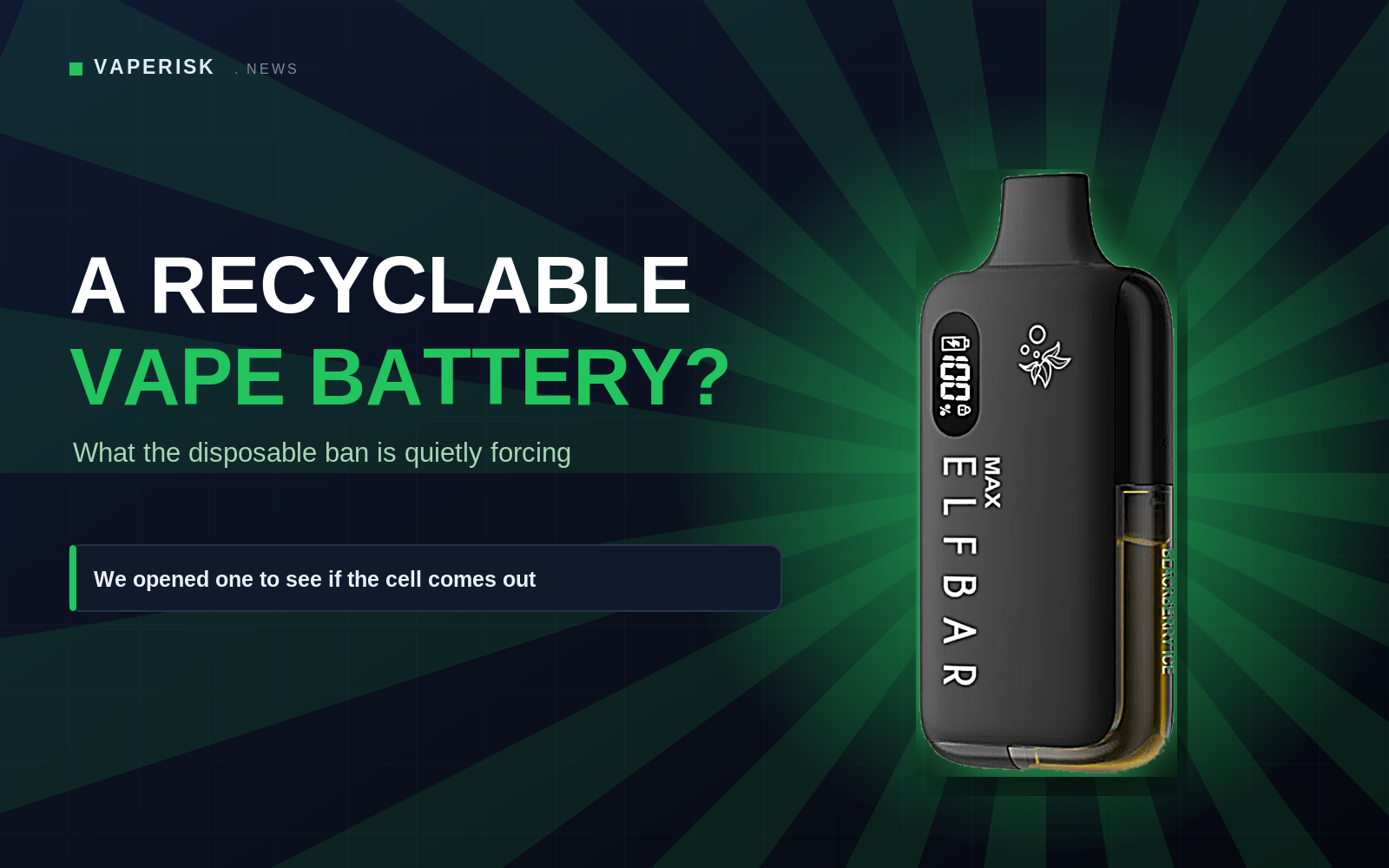
In the VapeRisk Elf Bar MAX teardown, the examined unit used a modular construction with spring contacts rather than soldered wires between the battery section and the board. The battery compartment could be separated as a component. That is stronger construction evidence than a generic recyclability claim on a product page.
It is still a one-sample finding. It does not prove that every market version, manufacturing lot or future revision uses the same construction. It also does not prove legal compliance, battery-recycler acceptance or safe consumer disassembly. A product claim should identify the exact model, market, manual, revision and intended removal method before generalising.
What buyers and retailers should check
- Is the device both rechargeable and refillable under the rule for the target market?
- Does the manufacturer explain how the complete battery is removed and replaced?
- Are replacement batteries or replacement product modules actually available for the required period?
- Does removal require proprietary tools, heat, solvents or destructive force?
- Which parts can the receiving recycler accept: complete device, removable battery, pod or e-liquid container?
- Does the retailer have a verified take-back and downstream collection route?
For US disposal, the route is different: EPA guidance tells consumers to use household hazardous waste collection and tells retailers to verify local permission and downstream arrangements before collecting devices. See how to dispose of vapes safely in the US.
FAQ
Are vape batteries recyclable?
The battery materials can be recyclable through an appropriate battery-recycling process, but the complete vape may need a household hazardous waste, electrical-waste or retailer take-back route. Do not assume it belongs in curbside recycling.
Does rechargeable mean the battery is removable?
No. Rechargeable describes normal charging. A rechargeable battery can still be sealed into the product and difficult to remove or replace.
Is the EU banning disposable vapes in February 2027?
The EU Batteries Regulation does not name a blanket disposable-vape ban. From February 18, 2027, Article 11 generally requires portable batteries in products to be removable and replaceable by the end user, subject to exceptions. Sealed vape designs may be affected, but exact scope and compliance require product-specific review.
Does the Elf Bar MAX have a removable battery?
The one unit VapeRisk examined had a modular battery compartment connected through spring contacts. That finding is limited to the examined sample and does not prove every revision or market version is identical.
Official and first-party sources reviewed
- GOV.UK: Single-use vapes ban – information for businesses
- EUR-Lex: Regulation (EU) 2023/1542 on batteries and waste batteries
- European Commission guidance on battery removability and replaceability
- European Commission: 2026 consultation on additional removability exemptions
- VapeRisk: Elf Bar MAX teardown and one-sample construction evidence
Evidence note: This article distinguishes official legal text from one-device construction evidence. It is not legal advice, a recycling-service endorsement or a claim that every product revision complies.