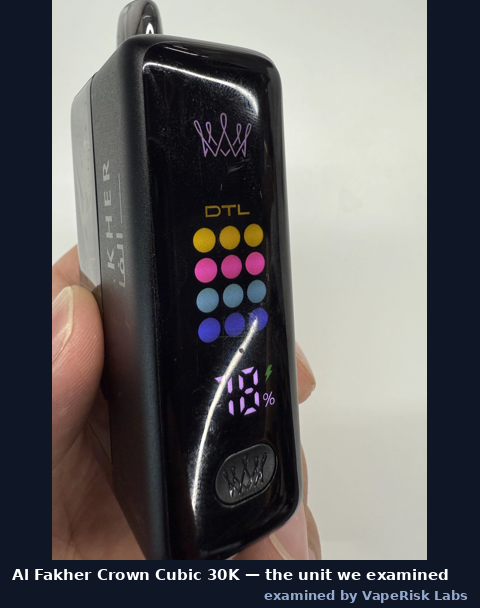
Updated 15 July 2026. VapeRisk Labs examined one Al Fakher Crown Cubic 30K to separate the claims and markings attached to that unit from what the hardware could support on the bench.
Quick answer: The examined Crown Cubic 30K used a 2 mL pod with a 10 mL refill reservoir, a magnetically attached 800 mAh battery rod, and two power and two airflow positions. Its separable, refillable architecture was observable on the sample. The teardown also found no pump or pressurisation in the refill path, a magnetic dock that needed a firm manual press on this unit, and no basis for verifying the 30,000-puff claim because VapeRisk did not run a puff-count test.
Evidence limits: This report covers one examined unit. The surviving public record does not identify its purchase source, market, acquisition date, batch or revision, and it does not contain repeated-unit or long-term testing. Bench figures below are single-unit observations. They must not be generalized into a product-wide quality, safety, lifespan or puff-count conclusion. See the VapeRisk testing methodology and the Claimed vs Measured dataset.
The buyer questions, answered
Is the examined unit refillable and separable? Yes. Its 10 mL reservoir could be refilled, while the battery rod separated from the cartridge and recharged over USB-C. That is a sample-level architecture finding, not proof of refill life, compatibility or recycling access in every market.
Does the 30,000-puff claim hold up? VapeRisk did not run a standardised puff test, so it makes no measured puff-count statement. The examined hardware contained a 2 mL pod, 10 mL reservoir and a cell marked 800 mAh; those observations do not validate a puff total.
Is the magnetic connection reliable? The rod and cartridge separated cleanly. On this unit, however, the magnetic dock stuttered and needed a manual press to seat fully. One sample cannot establish the failure rate or reliability of other units.
Why might the vape feel weak? Subjective use notes recorded with this unit describe a cool draw and thin-ish vapour, plus a child lock that’s easy to trigger by accident and fiddly to open. The hardware reason it’s a gentle vape: an atomizer with parallel mesh heating sections running at a measured ~18 W (MTL) / ~19 W (DTL) — modest by big-disposable standards.
Bench findings at a glance
| Question | Finding on this unit | Evidence boundary |
|---|---|---|
| Refill architecture | 2 mL pod plus a 10 mL refill reservoir; separable rechargeable battery rod. | Observed on one unit; refill cycle life and cross-SKU compatibility were not tested. |
| Refill path | No pump or pressurisation was found; liquid moves through the guide path and wick. | Component-level observation, not a timed refill-performance test. |
| Magnetic dock | The dock needed a firm manual press to seat on the examined unit. | Single-unit observation; no product-wide defect rate was measured. |
| Battery and charging | Cell marked 800 mAh / 3.7 V; about 0.8 A constant-current charging and about 53 minutes to full. | One bench run; instrument, calibration and repeatability records are not present in the public file. |
| Output | Approximately 18 W in MTL and 19 W in DTL under the recorded constant-RMS check. | Single-unit values, not a tolerance or production-consistency study. |
| Puff total | Not tested. | The 30,000 figure remains a claim associated with the examined product, not a VapeRisk measurement. |
Key specs — claimed vs found on the bench
| Spec | Claimed or marked on the examined product | VapeRisk Labs teardown (this unit) |
|---|---|---|
| Format | 2+10 refillable kit | 2 mL pod + 10 mL refill reservoir (confirmed) |
| Puffs | 30,000 (manufacturer claim) | Not tested — no standardised puff test run |
| E-liquid | 2 + 10 mL | 12 mL per fill (measured/confirmed) |
| Battery | 800 mAh | 800 mAh, 3.7 V, “111650” cell (marked) |
| Power | MTL 17 W / DTL 18 W | measured ≈ MTL 18 W / DTL 19 W (constant-RMS) |
| Atomizer | — | parallel mesh heating sections, ≈0.6–0.65 Ω equivalent (measured; ~1.3 Ω per section) |
| Airflow | 2 settings | 2 inlets, Ø1.4 mm / Ø1.8 mm; draw ≈150–155 Pa (open) / ≈390–410 Pa (closed) (measured) |
| Charging | — | ≈0.8 A constant current, ≈53 min to full (measured) |
| Dimensions | — | 90 × 46 × 25.1 mm (measured) |
What’s inside
The battery rod — modular and rechargeable
The battery side is a clean, reusable module: an aluminium shell around an 800 mAh “111650” cell, a small mainboard, a single side button, and a colour status screen. It mates to the cartridge by N52 magnets and charges over USB-C.
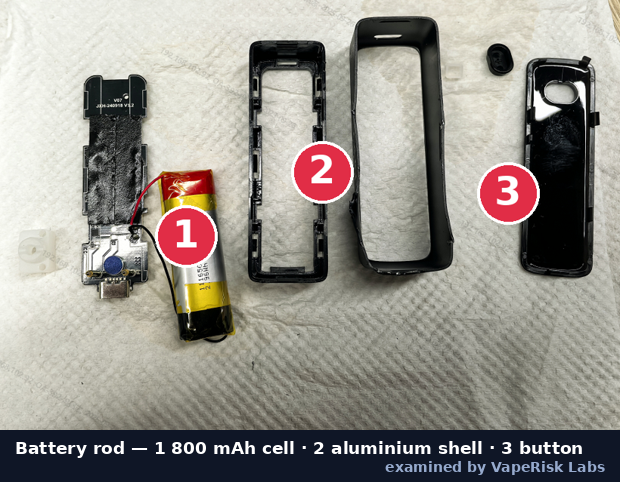
Battery-rod parts: 1 800 mAh cell · 2 aluminium shell · 3 button (with lens). Also inside: the mainboard, PC cell holder, mic silicone and two N52 magnets.
The cartridge — where the 2+10 refill lives
The cartridge is the busier half. A distinctive metal liquid-guide post transfers oil from the reservoir into the wick when the parts are assembled (it pierces a lower oil port). Around it sit the steel storage tube, storage cotton, the mesh-coil assembly, gold-plated electrode, airflow toggle, seals and an N52 magnet.
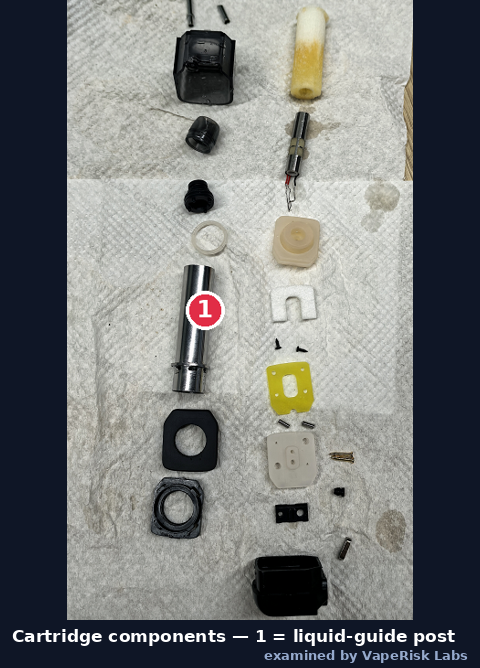
Cartridge parts (full list): 1 = metal liquid-guide post; plus the 10 mL reservoir (PCTG), steel tube (SUS), storage cotton, mesh-coil assembly, airflow toggle, gold-plated electrode, silicone seals and N52 magnet.
The 2+10 refill mechanism — reusable, but not instant
The 10 mL refill reservoir on the examined unit fed the wick through an open reservoir path: when assembled it pierced a port so liquid could move down the guide post into the steel tube and storage cotton. No pump or pressurisation was found in that path. This establishes the observed architecture, not a universal refill time or cycle-life result.
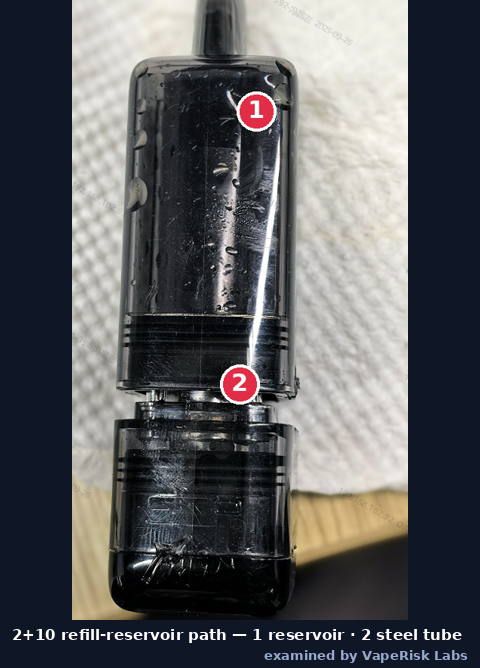
The 2+10 refill: 1 10 mL refill reservoir · 2 steel tube + storage cotton that feeds the atomizer.
The atomizer and wick
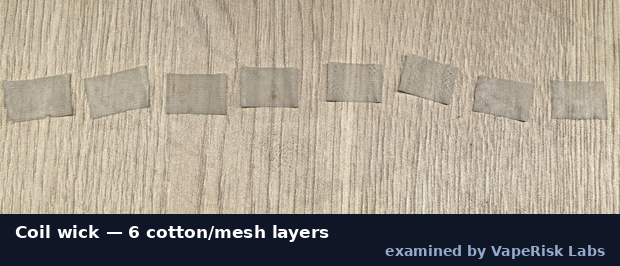
The atomiser uses parallel mesh heating sections wrapped in a six-layer wick (two linen, two mesh-cotton, four non-woven) designed to pull oil to the mesh and slow leaks. We measured the assembly at ≈0.6–0.65 Ω equivalent. It’s a gentle, MTL-leaning setup rather than a cloud machine — consistent with the cool, modest draw noted on this unit.
The mainboard
The board carries the MCU, a charge-management IC, the output MOSFET, the airflow (mic) switch and a USB-C input, driving the colour screen and the two power modes. We measured charging at ≈0.8 A constant current, ~53 minutes to full.
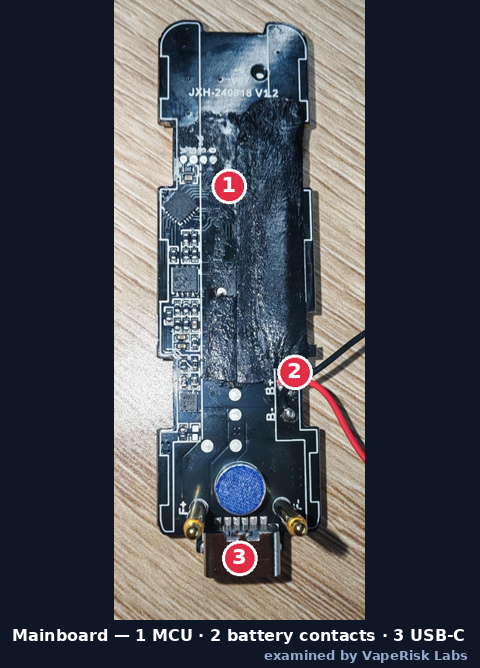
Mainboard: 1 MCU · 2 battery contacts · 3 USB-C input. One engineering note on this unit: the board carries no on-board coil-resistance detection — common in budget single-coil designs.
Safety-related observations (this unit)
These describe the unit we examined and are not a safety rating of the brand or of other units.
- Charge management: present — a dedicated charge-management IC with a USB-C input; we measured charging at ≈0.8 A constant current, ~53 min to full, with the cell marked 800 mAh / 3.7 V.
- Cell: a single “111650” 800 mAh cell, physically separable with the battery rod. Separability does not by itself establish a collection or recycling pathway in a reader’s market.
We’re limiting this section to what we could confirm on the board we examined. Where the teardown evidence on a component was mixed, we’ve left it out of this write-up and flagged it for a closer photo-level check rather than state it here.
Claim and observation matrix
| Claim or marking associated with the examined unit | What the teardown shows | Verdict |
|---|---|---|
| “2+10 refillable” | 10 mL refill reservoir plus 2 mL pod observed | Architecture observed on this unit |
| “Modular battery” | Battery rod separates by N52 magnets and recharges; the cell module is physically separable | Observed on this unit — the dock needed a firm press |
| “30,000 puffs” | 12 mL per fill + 800 mAh rechargeable cell | Manufacturer claim — not puff-tested by us |
| 2 power / 2 airflow | Measured ~18 W / ~19 W; two airflow inlets (1.4 / 1.8 mm) | Observed on this unit — the airflow toggle was not keyed against misassembly |
| (unstated) | No pressurisation = no instant refill; parallel ~0.6–0.65 Ω mesh = gentle draw | Teardown observations; not product-wide ratings |
How we examined this unit
This examination was carried out by VapeRisk Labs. We disassembled one Al Fakher Crown Cubic 30K to the component level, photographed the parts, and recorded materials, dimensions and electrical behaviour on the bench. Values derived from markings or product-associated claims are labelled separately from observations and bench measurements.
Known method limits: the public record does not include the sample’s purchase source, market, acquisition date, lot or revision; instrument model and calibration records; repeated runs; uncertainty; raw data; a standardised puff protocol; long-term refill cycling; or tests across multiple units. The measurements therefore describe this sample only. They are not a certification, safety approval, production-tolerance study or product-wide quality score. Read the site-wide testing methodology for the general evidence framework and the Claimed vs Measured dataset for the normalized result row.
Manufacturer-source status
A bounded source check on 15 July 2026 did not locate a directly retrievable first-party Crown Cubic 30K product page, manual, support page, authentication workflow or regional catalogue record. Search absence does not prove those resources do not exist. It means this update does not use another Crown product, retailer listing or search snippet to fill documentation gaps. Claims and markings remain tied to the examined sample and its retained record.
FAQ
Is the Al Fakher Crown Cubic 30K refillable?
The examined unit used a 2 mL pod on a 10 mL refill reservoir with a separable, rechargeable battery rod. VapeRisk did not test refill cycle life or every regional SKU.
Does it really do 30,000 puffs?
30,000 is Al Fakher’s manufacturer claim. We didn’t run a standardised puff test, so we make no measured puff-count statement. The hardware holds 12 mL per fill with an 800 mAh rechargeable cell.
How does the refill work — is it instant?
You fill the 10 mL refill reservoir; when assembled it pierces a port and oil feeds down a guide post into the wick. There’s no pump or pressurisation, so it’s reusable but not an instant fill-and-vape system.
What battery does it use and how fast does it charge?
A single “111650” 800 mAh, 3.7 V cell in the magnetic battery rod. We measured charging at about 0.8 A constant current, roughly 53 minutes to full over USB-C.
Is the magnetic battery connection reliable?
The rod and cartridge were physically separable, but on the examined unit the magnetic dock stuttered and needed a firm manual press to seat fully. One sample cannot establish the reliability of other units.
How much power does it make?
We measured roughly 18 W in MTL and 19 W in DTL (constant-RMS), close to the claimed 17 W / 18 W — a gentle, MTL-leaning output from parallel mesh heating sections at ~0.6–0.65 Ω equivalent.
Is this a product-wide rating or safety result?
No. It is a single-unit teardown and bench record. VapeRisk did not publish a numeric product score, puff-count result, safety certification, production-tolerance study or multi-unit reliability conclusion in this update.
Corrections and independent testing enquiries
Manufacturers, distributors and readers may submit dated technical evidence or correction requests through VapeRisk’s contact route. Organizations seeking clearly labelled independent testing, data sponsorship or advertising can review advertising and partnership options and the sponsorship standards. Payment does not buy a score, ranking, result or conclusion, and material relationships must be disclosed.