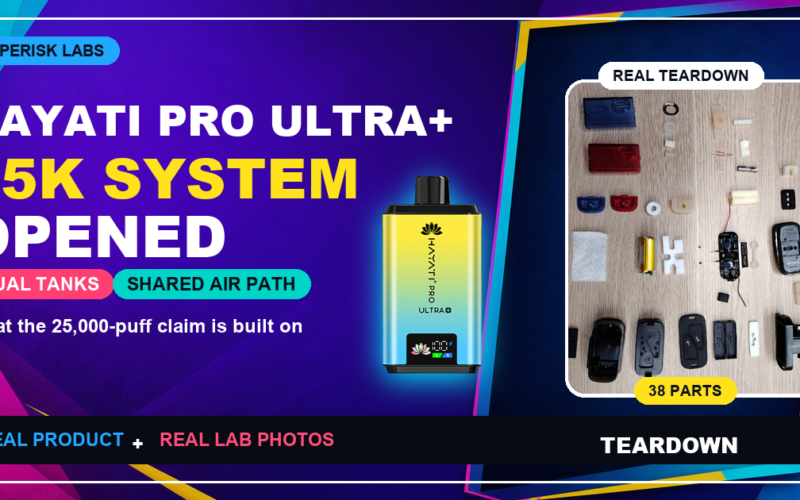
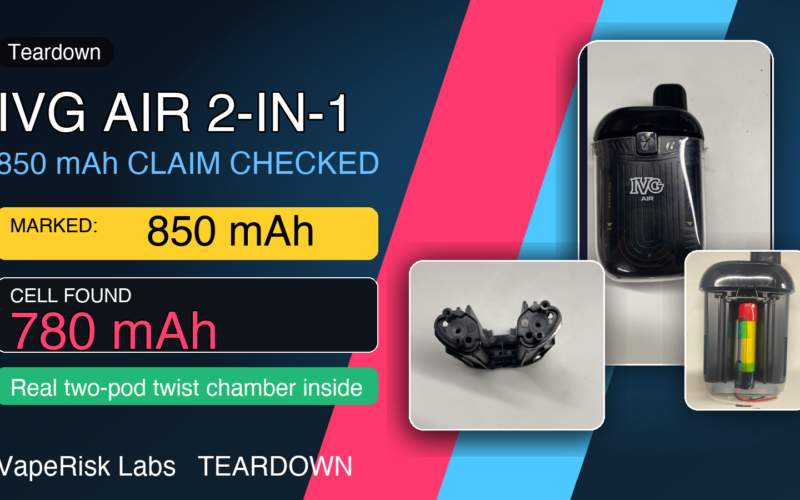
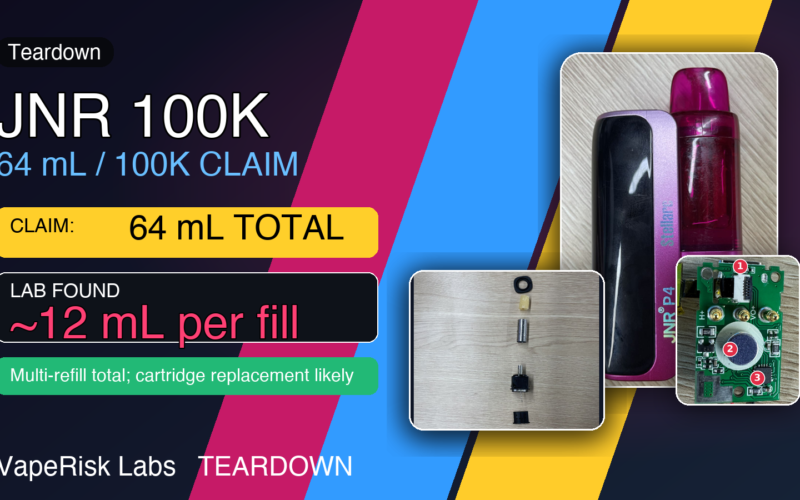
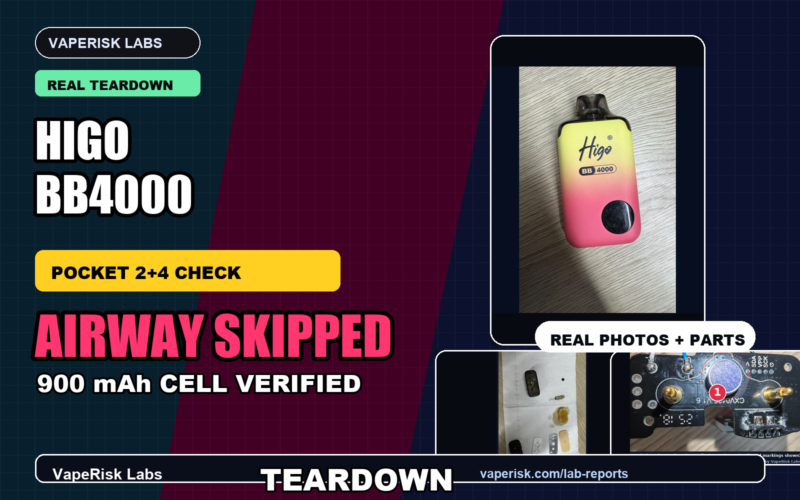
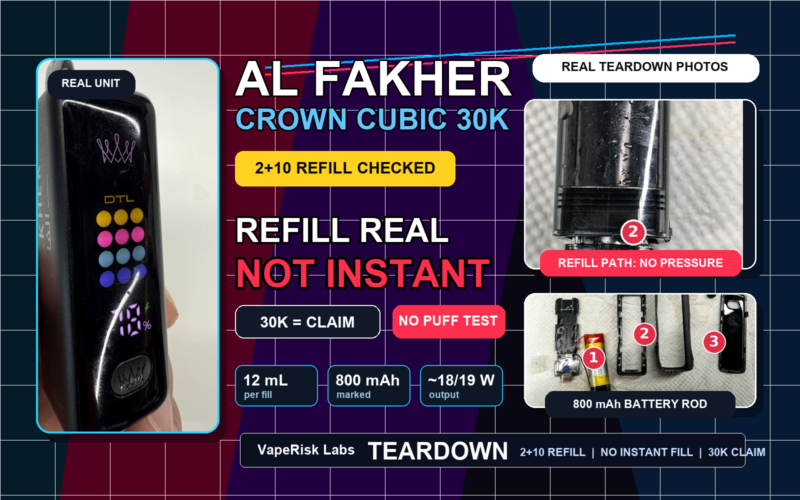
Quick answer: VapeRisk Labs publishes product teardowns, bench observations and claimed-versus-measured evidence for adult readers and industry professionals. Each report identifies the sample, method and evidence limits. VapeRisk does not describe an editorial teardown as accredited laboratory certification, and a sponsor cannot buy a result.
Updated July 21, 2026. Start with the Claimed vs Measured Findings hub or read the VapeRisk Testing Methodology before using a result outside the named sample and protocol.

Current vape teardown and claim evidence
| Evidence file | What the reported sample supports | Important limit |
|---|---|---|
| Vozol Rave 40000 teardown | Sample-level liquid, battery, construction and leak-risk observations compared with named claims. | One teardown does not prove every unit or the advertised puff total. |
| Vaporesso DOJO 0+10 teardown | Usable battery result, refill architecture and component observations for the reported sample. | The measured result belongs to the tested unit and protocol. |
| ELFBAR MAX teardown | 2+10 refill mechanism, piston, component count and removable-battery construction. | Construction evidence is not chemical, emissions or certification testing. |
| Claimed vs Measured | A maintained router for documented claim comparisons across current VapeRisk teardown files. | Dataset rows preserve their own source, sample and method boundaries. |
What VapeRisk can examine
- Device construction, internal layout, sealing, wiring, battery placement and serviceability.
- Battery markings, usable-capacity checks, charging behaviour and display accuracy under a stated protocol.
- Liquid-container, refill, pod and airflow architecture visible in an identified sample.
- Package and manufacturer claims that can be compared with documented sample evidence.
- Repeatable user-facing failure questions such as leakage, dry hits, refill behaviour and component access when the evidence is available.
Evidence labels and confidence
VapeRisk uses separate labels for a manufacturer claim, a source-reported fact, an editorial observation and a measurement. A result becomes stronger when the sample identity, equipment, conditions, repetitions, uncertainty and failure cases are documented. It does not become universal because it is precise.
The full method, corrections process and uncertainty rules are maintained in the Testing Methodology. Readers evaluating a third-party certificate or report should also use How to Read a Vape Lab Report.
The Review Policy defines the publication boundary between an exact-sample Review and a source-led Evidence File. The OXVA NeXLIM Evidence File is a current example: it records official model, pack, pod and manual evidence but carries no hands-on claim, measurement or score.
The Vape Juice Calculator makes its formulas, input limits and worked examples visible. It is an arithmetic WebApplication, not a laboratory measurement, product review or nicotine-target recommendation.
When an accredited external laboratory is required
Editorial teardown and bench work cannot replace testing that requires validated analytical chemistry, emissions equipment, electrical-safety certification, toxicology, accreditation or a regulator-defined method. Where a question exceeds VapeRisk’s equipment or competence, the correct outcome is to state the limit, obtain an appropriately scoped independent laboratory result, or leave the claim unresolved.
A laboratory name or accreditation logo is not enough by itself. The useful evidence is the laboratory’s current accreditation and exact scope, named method, sample identity, chain of custody, detection and quantification limits, quality controls, uncertainty, complete result and any deviation from the method. VapeRisk reports only what those records support.
How Lab reports are selected and updated
Priority goes to claims with meaningful adult-buyer, retailer, distributor or compliance consequences and to questions that can be tested with a documented method. A product being popular, supplied or sponsored does not guarantee coverage. Material corrections and product revisions are dated, and the original evidence boundary is preserved when a conclusion changes.
Lab capacity is deliberately limited. A strong evidence file may support a teardown report, a review update, a buyer-facing explainer and a row in Claimed vs Measured, but it should not be multiplied into near-duplicate pages.
Brand, laboratory and technology partnerships
VapeRisk may consider disclosed evidence-led proposals from adult-focused vape brands, accredited laboratories, test-equipment providers, component suppliers and compliance technology companies. A partner may fund an eligible format, provide a sample or submit records, but cannot choose the method outcome, suppress an unfavourable result, buy a ranking or describe editorial work as certification. Review the Sponsorship Standards and evidence-led partnership formats.
Frequently asked questions
Does VapeRisk run an accredited vape testing laboratory?
No. VapeRisk publishes editorial teardowns, bench observations and claim evidence under disclosed methods. It does not present that work as accredited analytical, toxicology, emissions or safety-certification testing.
Can a vape brand pay for a positive Lab result?
No. Commercial support, supplied products and source submissions are disclosed and separated from the method, findings and conclusion. A sponsor cannot buy a score, ranking or favourable outcome.
Does one vape teardown represent every unit?
No. A teardown supports observations about the identified sample. Batch variation, revisions, modes, liquids and use conditions may produce different results.
How should I evaluate a third-party vape lab report?
Check the laboratory’s accreditation and exact scope, method, sample identity, chain of custody, quality controls, uncertainty, complete results and deviations. Do not rely on a certificate image or isolated pass/fail claim alone.
Can VapeRisk certify that a vape is safe or compliant?
No. VapeRisk can report evidence and its limits, but does not certify product safety, legal compliance or regulator acceptance.
Apply the method: See our battery-capacity versus puff-count analysis for a worked example of how VapeRisk separates headline claims from observable specifications.